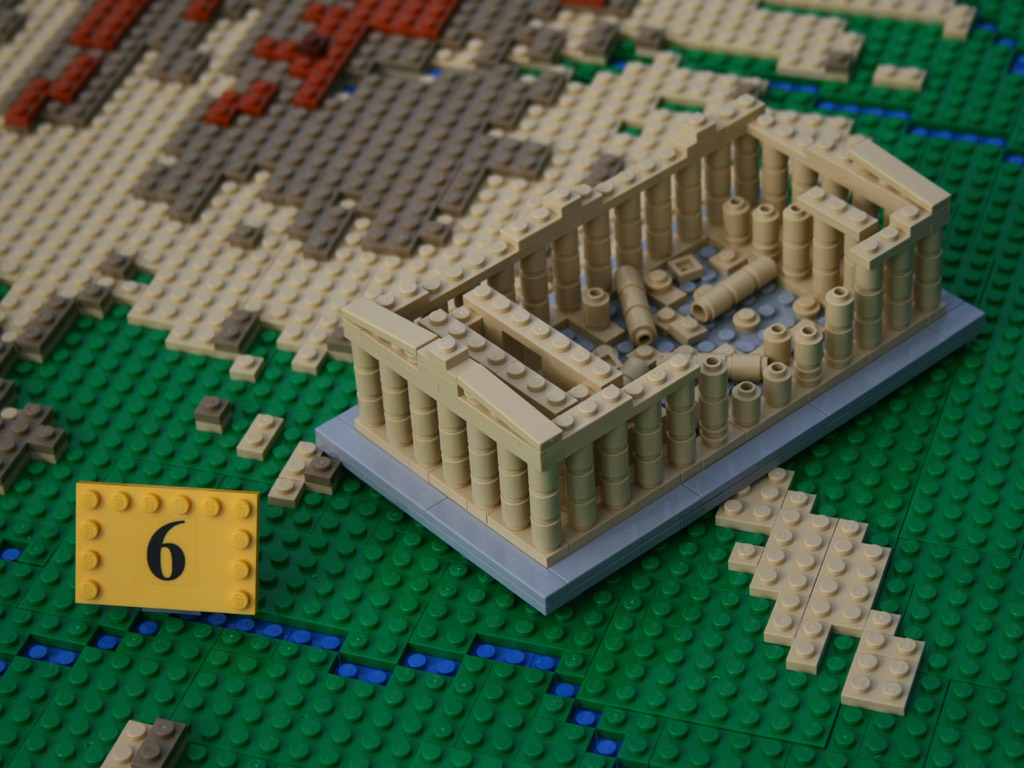
Overlooking modern Athens, the Parthenon is a reminder of days long gone. This icon of ancient Greece was a temple to the goddess Athena, patron of the city. It was built between 447 and 438 BC and housed a huge statue of Athena, though this wasn't really the site of sacrifices or other religious rites. In subsequent eras this was repurposed as a Christian church and a Muslim mosque. Torsten Scheer and Bruno Kurth built this microscale version.
This microscale creation was part of a huge collaborative display by European LEGO builders. Conceived by Tobias Reichling and Bruno Kurth, five builders constructed a huge (fifteen square meters) LEGO map of Europe and twenty different people contributed forty-four microscale versions of famous European landmarks.
In 1974, Spencer Kimball, prophet of the LDS church, called for young men to take up a mission to spread the word of Christ and the continuing revelation of the Book of Mormon. Today, over 50,000 young men and women are in the field each year for their two-year mission. Among them was AFOL and my fellow blogger over on MinilandBricks, Nathan Cunningham, who recently returned from his mission. A while ago, Bruce Lowell made this missionary, which seemed an appropriate model to put here. Missionaries travel in pairs, but Bruce only had one of those minifig torsos.
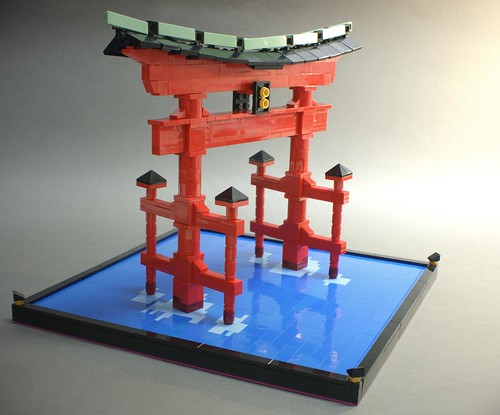
Along the same lines as the previous post, Matija Grguric just posted a great recreation of the Miyajima Torii, one of the most famous sights in Japan. At one point the entire island of Itsukushima was considered holy, and common people could not set foot on the ground there. A shrine to the daughters of the Shinto god of the sea and storms, Susanoo, stands on piers out over the water. The shrine would be approached by boat, and adherents would sail through the gate sitting out in the bay.
At Shinto shrines, and also some Buddhist temples, Torii gates mark the division between to ordinary world and the sacred space. At the BrickCon gathering of LEGO builders in Seattle this past weekend, the Brothers-Brick organized a collaborative display around the theme "Big in Japan". Robin Sather certainly fit the theme with his massive Torii gate. I'd be curious to learn the translation of the text, which you can see better here. This is technically a ryobu torii, and seems pretty authentic in design. I wonder if it was based on a specific real example.
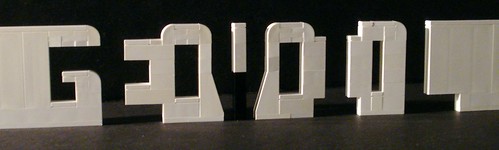
From Thomas Aquinas' Summa Theologica: "But evil has no formal cause, rather is it a privation of form; likewise, neither has it a final cause, but rather is it a privation of order to the proper end; since not only the end has the nature of good, but also the useful, which is ordered to the end. Evil, however, has a cause by way of an agent, not directly, but accidentally." Alex Eylar illustrates this nicely in LEGO form.
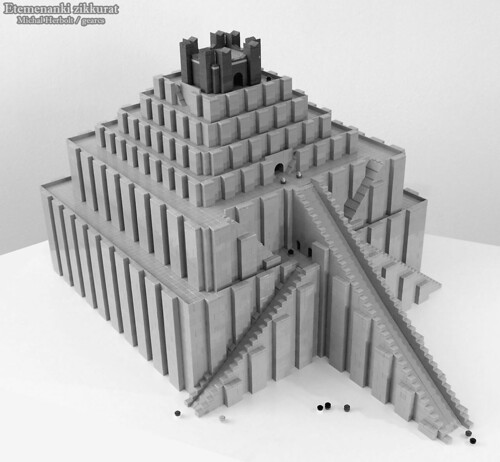
Built in the ancient Mesopotamian valley, ziggurats were great stepped pyramids that dominated the landscape. At the tops (closer to the sky) were great shrines, where sacrifices were offered to the gods. The Etemenanki Ziggurat in Babylon was dedicated to Marduk and survived until the third century BC, but their is debate over when it was built. It may have been the great ziggurat described in literature going back two thousand years BC, or it may have been built as recently(?) as 900 BC. It has been suggested that this great pyramid may have been the basis for the story of the Tower of Babel. Recently a LEGO version was unveiled by Michal Herbolt, aka gearcs:
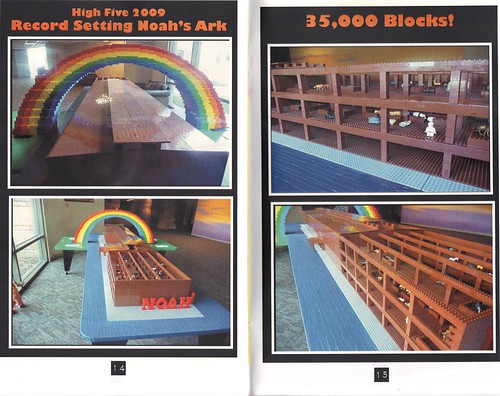
A couple of days ago I mentioned the Harvest Bible Chapel construction of a giant Noah's Ark last year as part of their Vacation Bible School program. TFOL and Harvest member Casey McCoy was able to get me some additional photos of their final product.
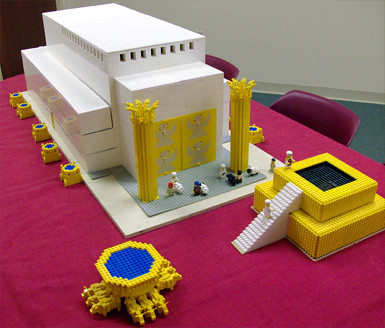
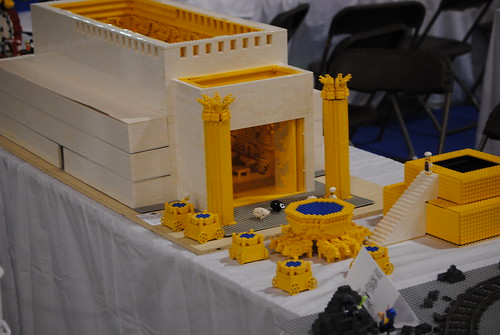
You may remember from last year that kids attending Vacation Bible School at the Harvest Bible Chapel in Illinois built a giant Noah's Ark from LEGO. This year they had another project, Solomon's Temple. TFOL (that's Teen Fan of LEGO) Casey McCoy is a member of that church and helped out, and he took extensive photos of the event.
I've been really busy lately and haven't been blogging, so I missed Yom Kippur. This day, the 'Day of Atonement', closes out the High Holy Days of the Jewish religious calendar. During the days of the Temple in Jerusalem, on this day the high priest brought a sacrifice into the Holy of Holies to ask God for forgiveness for the sins of the nation. Today's Jews observe the day with prayer and fasting. To note the day (belatedly), let's take another look at Tbone TBL's LEGO rendition of Solomon's Temple.
From Equinnox: Be not conformed to this world, but be transformed by the renewal of your mind, that by testing you may discern what is the will of God, what is good and acceptable and perfect.
According to John 2:1-11, Jesus first miracle took place at a wedding in Cana. After the wine ran out during the festivities, Jesus asked the servants to fill up jars with water, and when they tasted from the jars they were the finest wine. Minkowsky reproduced this miracle with a touch of humor in a recent MOC. You have to watch the movie to get the full effect. Be sure to look through the whole gallery for some great details.
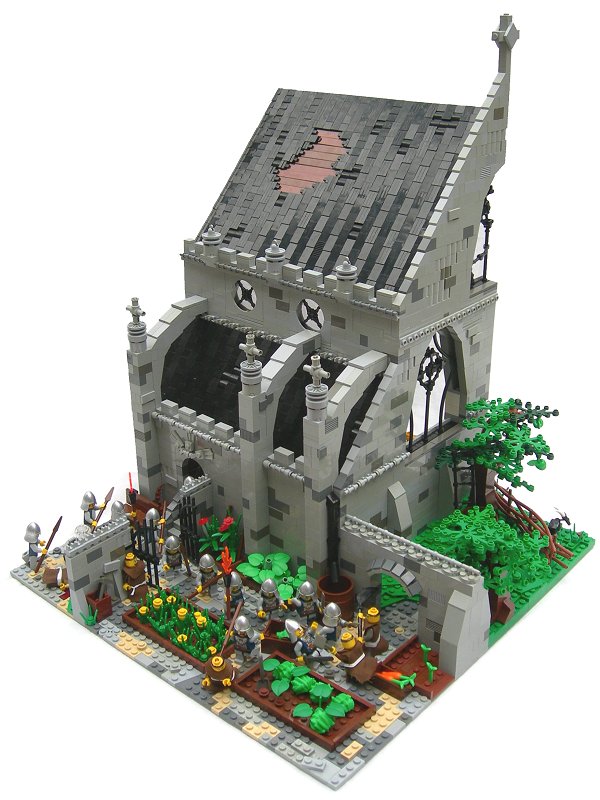
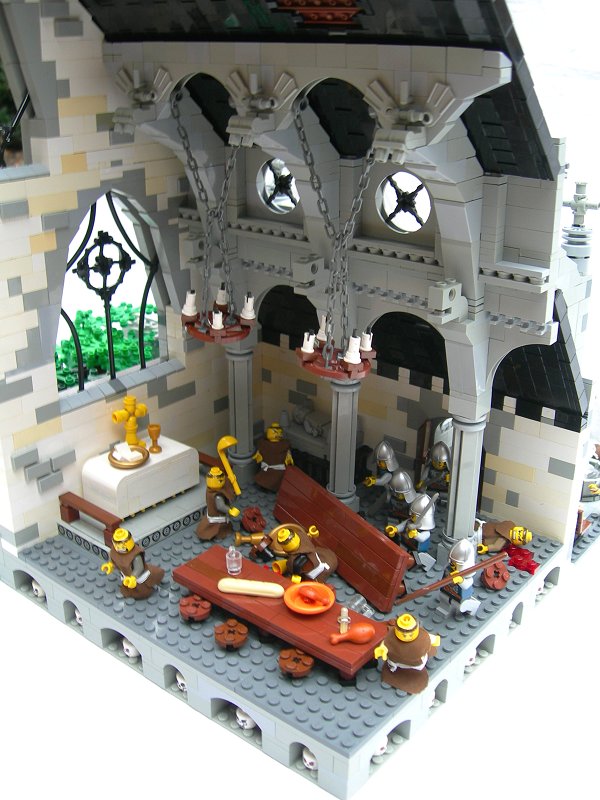
England's Henry VIII was locked in a struggle with the Catholic Church, including over his desire to divorce Catherine of Aragon. This finally resulted in the Act of Supremacy in 1534, declaring the Church of England with himself as head. The monasteries continued to be a center of Catholic power, with the monks holding large amounts of property and acting as local authorities. The Suppresion Acts of 1536 and 1539 declared that these monasteries were disbanded, and their property was taken over by the state. SlyOwl illustrated this, winning the religious life category from last year's Colossal Castle Contest.
Among Native American traditions from the southwestern United States, Kachinas were spirit beings who inhabit all aspects of the world around us. Members of the tribe also dressed as Kachina to dance in religious ceremonies, and carved dolls were given to their children. Dave Shaddix presents three LEGO Kachina from the Hopi pantheon: from left to right - Talavai, who sings at the break of day, Angwusnasomtaka, or Crow Mother, the mother of the Kachina, and Palavitkuna, who participates in traditional footraces.
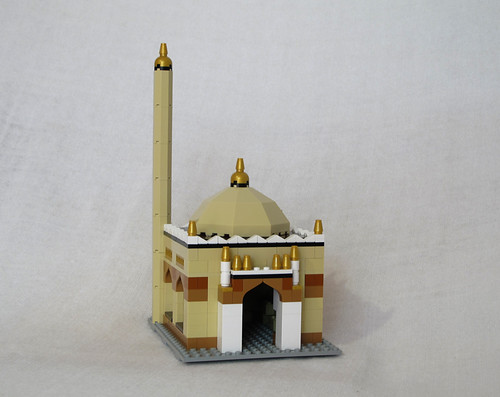
Okay, maybe one of my Muslim readers could help teach me the proper greeting for this month (Blessed Ramadan? Peace be upon you?), but we are in the midst of the month of Ramadan. Muslims fast during the days of this month, remembering the initial revelation of the Qur'an to Mohammed. 1wave posted this mosque at the start of the month, and says it is the start of an upcoming diorama. So watch his account for the fuller creation to come. This is also a good place to note that GodBricks got a great review on PhiloSufi, a blog by two Canadian Muslims. Thanks to Deborah for the great review and also for pointing it out to me.
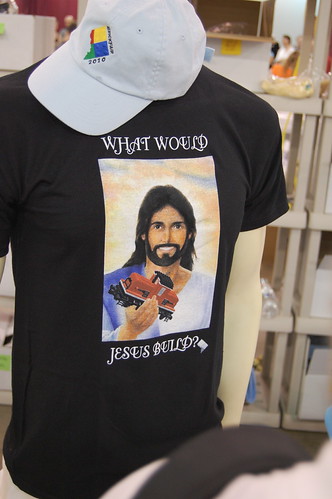
Long time readers of this blog might remember that I wrote an essay on WWJB?, or 'What Would Jesus Build?'. Someone at the recent BrickFair fan convention produced this t-shirt. Personally, I think I should get some royalties if they were selling these. Or maybe someone should send me a shirt. :) Photo credit to OmahaMH.
HKLug members have really helped to increase the number of eastern religious MOCs on this blog. In the Hong Kong LEGO contest I've recently covered here, there were two versions of the Tian Tan Buddha overlooking Lantau Island. Schfio has a larger version of this statue, that was shown as part of a HKLug display of several MOCs highlighting Chinese culture at ACGHK 2010, the Animation Comic Game Hong Kong convention.
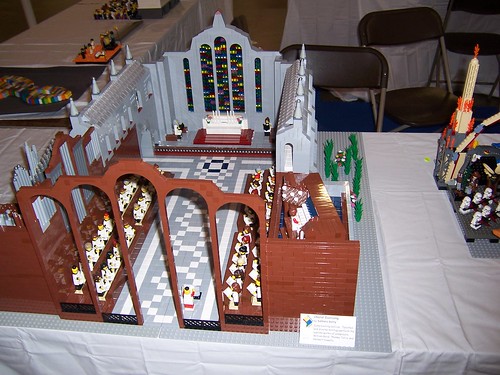
Another creation on display at BrickFair 2010 was Barbara Barry's Choral Evensong (photo credit to Danny316p). Her explanation card reads: "Sung evening service. Talented and diverse minifigs perform the sublime works of composers William Byrd, Thomas Tallis, and Herbert Howells."
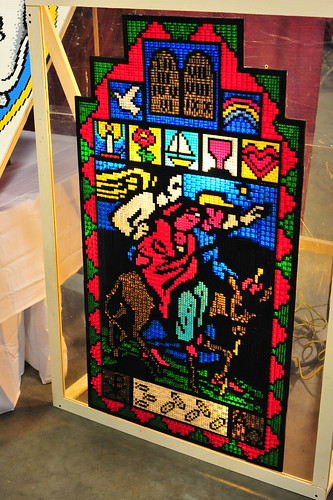
It looks like Mike Ripley also displayed his Flight to Egypt mosaic at BrickFair (photo credit goes to Jeremy Schultz).
From the explanation card, it appears that, like his Luther Seal in the last blog post, this was also a family fun night activity, with over 50 participants building sections that were then assembled into the whole mosaic. The subject is a woodcut by Elisabeth Reuter, 'Flight to Egypt', depicting Joseph and Mary escaping from Herod's men with Jesus and fleeing to safety in Egypt, as recounted in Matthew 2:13-15.
BrickFair 2010 was held this weekend near Washington, DC. Among the many creations on display at this gathering of LEGO fans was Mike Ripley's rendition of the Seal of Martin Luther (photo credit goes to Andrew Albosta).
Designed for Martin Luther in 1530, this seal contains many symbolic elements. The cross in a heart symbolizes Christ's sacrifice and a belief in this 'from the heart'. The white rose symbolizes joy, comfort and peace. The blue field is for a heavenly future surrounded by a golden ring symbolizing eternity. This seal has become a symbol for Lutheranism. A little bit of digging led to this explanation by Mike Ripley.
As he explains, this mosaic was designed by him as a group activity for a family fun night at his (Lutheran) church. Over 50 participants, including many kids, made 16x16 squares, that then got assembled to make the whole seal. From the video footage it looks like this was a great event, and the result is quite striking.