Showing posts with label Brick Testament. Show all posts
Showing posts with label Brick Testament. Show all posts
Friday, May 1, 2015
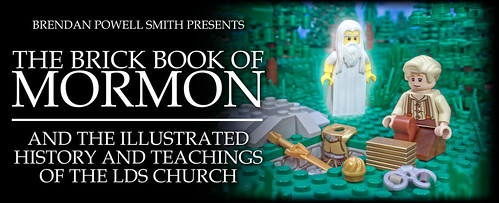
Brick Book of Mormon
Brendan Powell Smith of Brick Testament fame has announced a new project, the Brick Book of Mormon. You can read more here, but it looks like he is just in the planning stages at this point. No estimated time when this will result in fully illustrated stories. I'm looking forward to seeing his take.

Thursday, November 8, 2012
Book review: The Brick Bible: The New Testament
Note - I'm posting this book review across all of my blogs. I will add some blog-specific material at the end of the review where appropriate.
I was very happy to get my copy of Brendan Powell Smith's latest work The Brick Bible: The New Testament, published by Skyhorse Publishing. Those in the online LEGO community are probably already aware of Brendan's 11 year old ongoing project, the Brick Testament, in both its online and print incarnations. To you, all I really need to say is that this is a beautifully produced paperback version including many of his New Testament stories, presented in a graphic novel style. Several of the stories have been re-built and re-photographed to update the stories reflecting newer LEGO figures, elements and colors, as well as Brendan's evolving building skills over a decade of work. There is also a Kindle version, but IMO if you're going to look at this on a screen, you're just going to go straight to his website. The huge benefit of this is that you can actually hold it in your hands and flip through the pages.
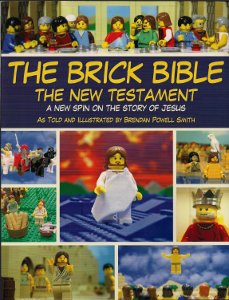
For others, I suppose some further explanation is warranted. Back in the fall of 2001 Brendan showed off his initial work to the LEGO community:
As he described it in that post, his Brick Testament is a LEGO illustration of the Bible. He immediately got a lot of feedback from the community, and as he added content to his site, he also got noticed by the mainstream press with newspaper and magazine stories, appearances on radio and television, and countless blog posts, tweets, forum discussions and the like (and one notable two part interview ;) ). Over the years, his work has led to at least seven print versions.
Brendan's work has not gone free of controversy. He is not personally a religious man, and one of his stated goals is to get people to reexamine the Bible, not just their vaguely-remembered Sunday School story version. He just takes the raw text and illustrates it in a pretty literal way. I won't do this here, but elsewhere (on Lugnet and on my GodBricks blog) I've taken issues with some of his interpretive choices. Brendan has always been gracious to discuss these differences, and I've enjoyed conversations with him over the years. Also, as he noted even in his first posting back in 2001, the Bible is full of violence and sex, and he has never shied away from illustrating this in LEGO form in the online version of his work. A year ago there was a little tempest in a tea pot when Sam's Club removed his books from their shelves due to complaints over that. I have elsewhere mocked that decision, but I do want to note here for anyone considering purchasing the Brick Bible for their kids, there are no plastic toy figures placed near each other in such a way as to suggest sexual situations in the print version (plastic toy violence is another thing altogether). So, if you are highly offended by plastic toy figures placed near each other in such a way as to suggest sexual situations (PTFPNEOISAWATSSS for short), have no fear. You can buy this book in peace. Now, if you are more concerned that his interpretation of certain Bible passages doesn't match yours, well, I may share your view, but that would also mean that you have to also keep a close eye on every other Biblical interpretation in popular media from Charlton Heston parting the Red Sea on to animated vegetables singing silly songs. The key is just to be an intelligent reader, and, if you are buying this for your kids, read along with them and discuss the stories.
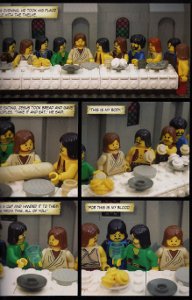
Now, I should spend a few minutes on this book, specifically. In large part it covers the same ground that you can find on his website, though with a different format (i.e. the website has single photos with text underneath, while this book version is laid out like a graphic novel, as you can see above). Several of the stories have been re-built and re-photographed (though not all - for example at one point the Magi are riding brick-built camels and at another Jesus tells how it is easier for a molded camel to go through the eye of the needle, so presumably the Magi photo is from before LEGO first produced the camel element in 2010). One striking difference is the lack of speech bubbles.

In the web version, Brendan uses black text in speech bubbles to indicate direct quotes from the Bible, but he sometimes has the characters make humorous asides, indicated by gray text. I kind of miss the speech bubbles and the side jokes, but I think I understand why Brendan did not include those in this. The other discrepancy between the print and web versions is simply in the choice of which material to include. Over half of the book is devoted to stories from the life of Jesus, which seems appropriate, but it seems that a third of the pages devoted to the book of Revelations seems out of scale. What's left on the cutting room floor is Brendan's treatment of the epistles of Paul, which are some of my favorite of his work.
That said, I highly recommend you get this book. Both religious and non-religious readers will enjoy the presentation. LEGO builders will particularly enjoy and appreciate seeing how Brendan translated different scenes into brick form.
GodBricks-specific content - The whole thing. I won't go into further discussion in this post, but I have often discussed Brendan's work on this blog.
I was very happy to get my copy of Brendan Powell Smith's latest work The Brick Bible: The New Testament, published by Skyhorse Publishing. Those in the online LEGO community are probably already aware of Brendan's 11 year old ongoing project, the Brick Testament, in both its online and print incarnations. To you, all I really need to say is that this is a beautifully produced paperback version including many of his New Testament stories, presented in a graphic novel style. Several of the stories have been re-built and re-photographed to update the stories reflecting newer LEGO figures, elements and colors, as well as Brendan's evolving building skills over a decade of work. There is also a Kindle version, but IMO if you're going to look at this on a screen, you're just going to go straight to his website. The huge benefit of this is that you can actually hold it in your hands and flip through the pages.
For others, I suppose some further explanation is warranted. Back in the fall of 2001 Brendan showed off his initial work to the LEGO community:
Hello, all.
I have embarked on a mammoth new project: interpreting the Bible in LEGO. I have plans for both Old and New Testament stories, but decided to start from the very beginning. I present to you the first fruits of my labor, six stories from the book of Genesis.
Enjoy, -The Rev. Brendan Powell Smith
As he described it in that post, his Brick Testament is a LEGO illustration of the Bible. He immediately got a lot of feedback from the community, and as he added content to his site, he also got noticed by the mainstream press with newspaper and magazine stories, appearances on radio and television, and countless blog posts, tweets, forum discussions and the like (and one notable two part interview ;) ). Over the years, his work has led to at least seven print versions.
Brendan's work has not gone free of controversy. He is not personally a religious man, and one of his stated goals is to get people to reexamine the Bible, not just their vaguely-remembered Sunday School story version. He just takes the raw text and illustrates it in a pretty literal way. I won't do this here, but elsewhere (on Lugnet and on my GodBricks blog) I've taken issues with some of his interpretive choices. Brendan has always been gracious to discuss these differences, and I've enjoyed conversations with him over the years. Also, as he noted even in his first posting back in 2001, the Bible is full of violence and sex, and he has never shied away from illustrating this in LEGO form in the online version of his work. A year ago there was a little tempest in a tea pot when Sam's Club removed his books from their shelves due to complaints over that. I have elsewhere mocked that decision, but I do want to note here for anyone considering purchasing the Brick Bible for their kids, there are no plastic toy figures placed near each other in such a way as to suggest sexual situations in the print version (plastic toy violence is another thing altogether). So, if you are highly offended by plastic toy figures placed near each other in such a way as to suggest sexual situations (PTFPNEOISAWATSSS for short), have no fear. You can buy this book in peace. Now, if you are more concerned that his interpretation of certain Bible passages doesn't match yours, well, I may share your view, but that would also mean that you have to also keep a close eye on every other Biblical interpretation in popular media from Charlton Heston parting the Red Sea on to animated vegetables singing silly songs. The key is just to be an intelligent reader, and, if you are buying this for your kids, read along with them and discuss the stories.
Now, I should spend a few minutes on this book, specifically. In large part it covers the same ground that you can find on his website, though with a different format (i.e. the website has single photos with text underneath, while this book version is laid out like a graphic novel, as you can see above). Several of the stories have been re-built and re-photographed (though not all - for example at one point the Magi are riding brick-built camels and at another Jesus tells how it is easier for a molded camel to go through the eye of the needle, so presumably the Magi photo is from before LEGO first produced the camel element in 2010). One striking difference is the lack of speech bubbles.
In the web version, Brendan uses black text in speech bubbles to indicate direct quotes from the Bible, but he sometimes has the characters make humorous asides, indicated by gray text. I kind of miss the speech bubbles and the side jokes, but I think I understand why Brendan did not include those in this. The other discrepancy between the print and web versions is simply in the choice of which material to include. Over half of the book is devoted to stories from the life of Jesus, which seems appropriate, but it seems that a third of the pages devoted to the book of Revelations seems out of scale. What's left on the cutting room floor is Brendan's treatment of the epistles of Paul, which are some of my favorite of his work.
That said, I highly recommend you get this book. Both religious and non-religious readers will enjoy the presentation. LEGO builders will particularly enjoy and appreciate seeing how Brendan translated different scenes into brick form.
GodBricks-specific content - The whole thing. I won't go into further discussion in this post, but I have often discussed Brendan's work on this blog.
Wednesday, September 19, 2012
Jesus is coming ...
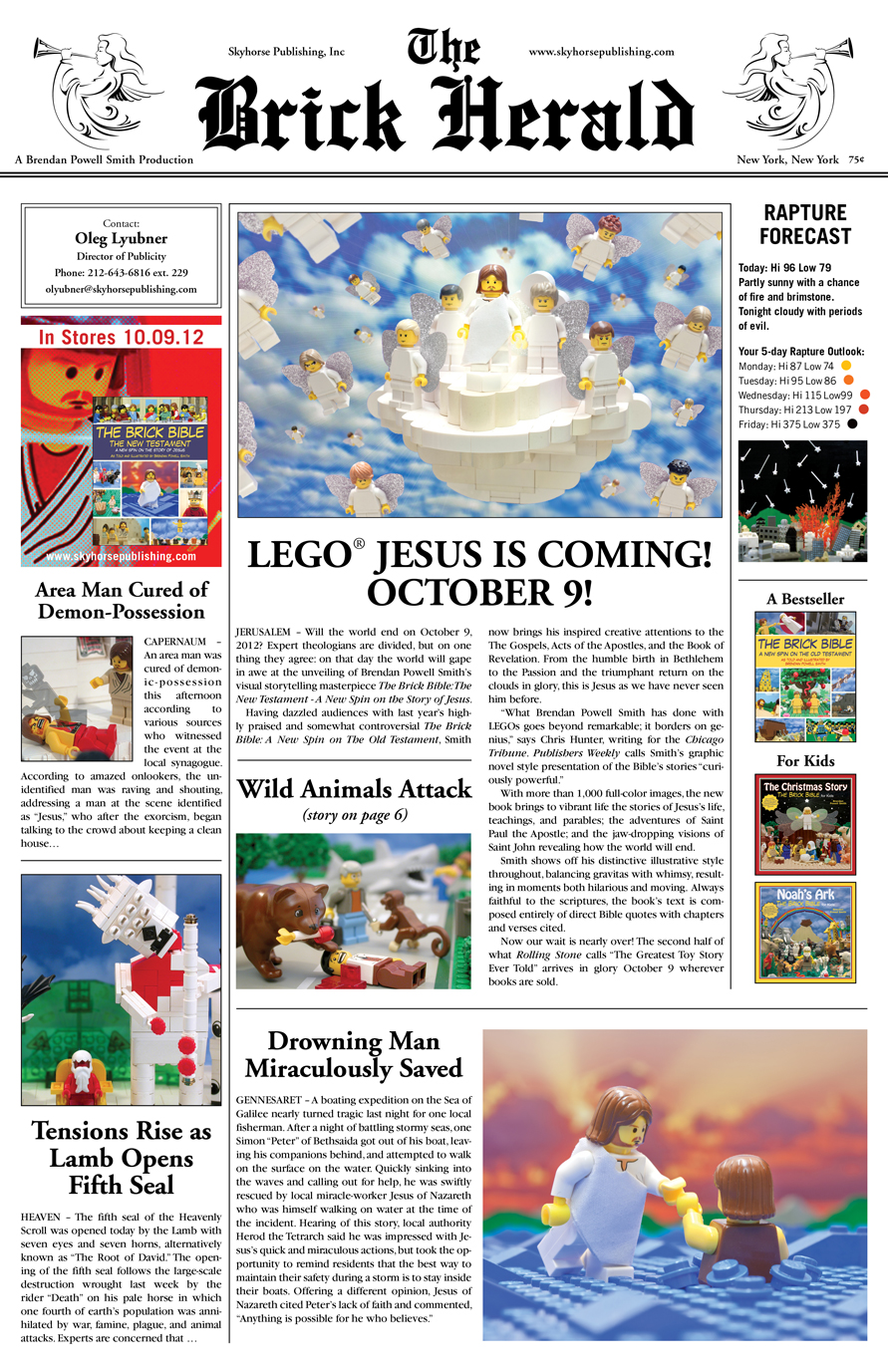
... at some point (But of that day or hour no one knows, not even the angels in heaven, nor the Son, but the Father alone. - Mark 13:32). In the meantime, you'll have to make do with The Brick Bible: The New Testament: A New Spin on the Story of Jesus by Brendan Powell Smith, set for release on October 9.
Monday, August 20, 2012
More water walking
Then Peter got down out of the boat, walked on the water and came toward Jesus. But when he saw the wind, he was afraid and, beginning to sink, cried out, “Lord, save me!” - Matthew 14:29-30.
Brendan Powell Smith illustrated this scene for his upcoming book: The Brick Bible: The New Testament. Here's his original version.
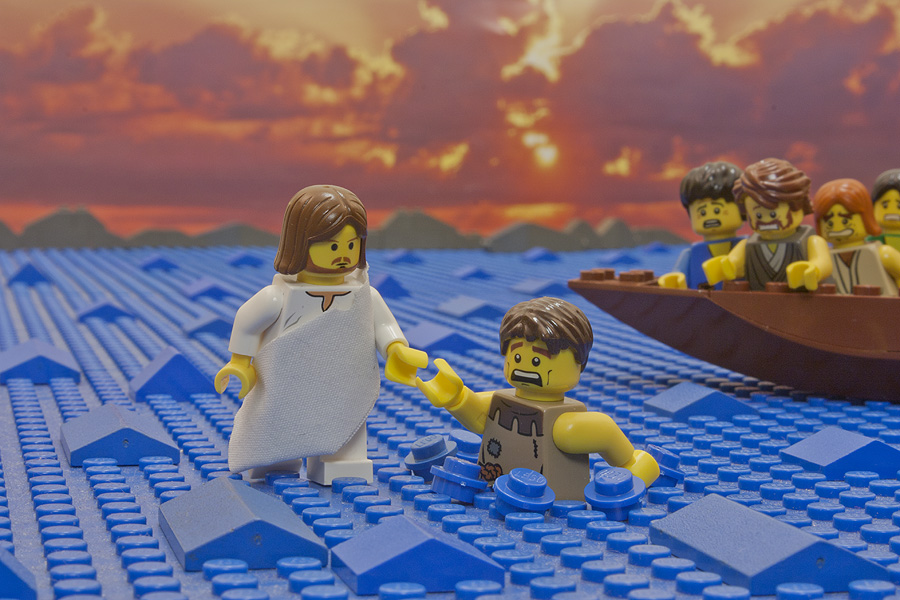
Brendan Powell Smith illustrated this scene for his upcoming book: The Brick Bible: The New Testament. Here's his original version.
Wednesday, May 16, 2012
Noah's Ark: The Brick Bible for Kids
I think this actually just came out yesterday. Brendan Powell Smith has released another book entitled Noah's Ark: The Brick Bible for Kids. You can get this on Amazon, Barnes and Noble, or a signed copy though Brendan's site. It appears that this is a total rebuild and reshoot of the story as seen on the Brick Testament (which itself was a rebuild of his original version from 2002, so this is his third time at this story). At 32 pages with only a few words per page, this is focused on (from what we can see in the preview images) beautiful photography. This is a children's book and looks very age appropriate.*,**,*** I'm totally going to buy this for my kids.
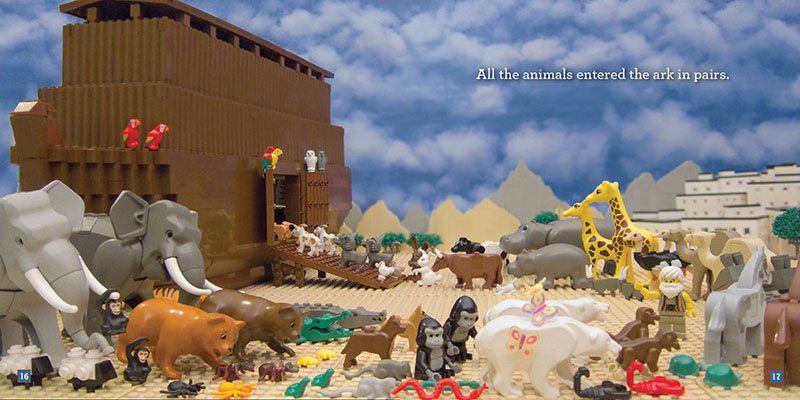
* For those who may not know Brendan's work (and is there anyone who reads this blog who doesn't?), he will occasionally label his stories with warnings for violence or sexual content, and as I recall, in the original version of his story from 2002, when God looked down on the earth and saw if full of sin, we saw illustration that had some implied sexual goings-on. In this version (you can preview this page on Amazon) you see people fighting, some with weapons implying murder or war, some blood, and someone stealing a purse.
** This, of course, completely glosses over the question over why sexual content is age-inappropriate but violence and murder is age-appropriate. I'll leave that for other parents to debate. We do let our kids see movies with non-graphic violence, and even play with toy squirt guns. I realize that makes me a horrid parent in some people's eyes.
*** And of course, even more blatantly, this glosses over the question of whether the whole story where God decides to wipe out all of humanity aside from eight people is age appropriate in the first place. I'm sure Brendan would be the first to point this out.
* For those who may not know Brendan's work (and is there anyone who reads this blog who doesn't?), he will occasionally label his stories with warnings for violence or sexual content, and as I recall, in the original version of his story from 2002, when God looked down on the earth and saw if full of sin, we saw illustration that had some implied sexual goings-on. In this version (you can preview this page on Amazon) you see people fighting, some with weapons implying murder or war, some blood, and someone stealing a purse.
** This, of course, completely glosses over the question over why sexual content is age-inappropriate but violence and murder is age-appropriate. I'll leave that for other parents to debate. We do let our kids see movies with non-graphic violence, and even play with toy squirt guns. I realize that makes me a horrid parent in some people's eyes.
*** And of course, even more blatantly, this glosses over the question of whether the whole story where God decides to wipe out all of humanity aside from eight people is age appropriate in the first place. I'm sure Brendan would be the first to point this out.
Sunday, November 27, 2011
Bible too racy for Sam's Club
Apparently Sam's Club rejected the Brick Testament. The company responded to inquiries saying "Sam's Club received numerous concerns from our members and parents about the mature content in what is perceived as a children's book. Accordingly, Sam's Club made a business decision to discontinue sales." It appears that the company got a few e-mails (or maybe just one?) complaining that Brendan is an atheist, and that on his website (NOT in the book) there were offensive depictions of sexual activity. Wow! Gee whiz! They've uncovered some deep dark secret that was, um, never a secret, and explicitly stated way back in 2001 (shoot, I missed celebrating the 10 year anniversary of the BT a month ago). There is a long discussion on Facebook where you can interact with the person that may be behind the initial complaints to Sam's Club.
BTW, while Brendan may have lost out here financially, since there will be fewer sales of his book (and to help remedy that, see below), IMO he won rhetorically. He has oft stated that one of his goals is to make people look at the Bible and judge it, not just go on the redacted version they got through Sunday School when they were little. Also IMO, I think both Brendan and small minded people like (IMO) the complainers here have a complete misunderstanding of the Bible. They all think that the Bible is meant to be a guide book for right living, full of upstanding moral examples. To Brendan the Bible fails at this, and so he rejects it. The complainers simply seek to ignore the failings of Biblical figures, and so stick to their Sunday School version. I'm sitting in my son's room right now as I type this (because I'm waiting for the baby to wake up and she's in the crib, okay, that was unneeded information), and there on the shelf is a Children's Bible with about twenty or so nice stories. I think that's what these complainers want the Bible to be. But it's not. The Bible is about God's quest to save a stupid, stubborn sinner like me (and you and you and you). God doesn't work through moral paragons, but through a deceiver like Jacob and an adulterer like David as the ancestors of Jesus, a bullheaded Peter as one of his closest friends and leader of his church, heck, the whole nation of Israel that was constantly turning away from Him to chase after other false gods. He did this so that none could boast that we were saved through our own righteousness, or that of our forebears. Any righteousness we might have is just dirty rags, as Paul writes. Instead, he saves us by pure grace, despite all of that. So, IMO, both Brendan and Tabitha Grace fall into the same pitfall. The Bible is not meant to be a perfect little book full of nice sayings, stories, and rules to live by. It is the story of God's encounter with humanity, a humanity that lusts, hates, covets, lies, kills, and ultimately denies that God. And yet He died on Calvary to save us.
Okay, end of sermon. I've shared these ideas before in discussions with Brendan on the old, now largely defunct, Lugnet, and in some of my reviews here. I disagree with him philosophically, and yet I love what he has built out of LEGO. If you're looking to buy the Brick Testament, perhaps as a Christmas gift for that AFOL in your life, you can go to Amazon or Barnes & Noble.

BTW, while Brendan may have lost out here financially, since there will be fewer sales of his book (and to help remedy that, see below), IMO he won rhetorically. He has oft stated that one of his goals is to make people look at the Bible and judge it, not just go on the redacted version they got through Sunday School when they were little. Also IMO, I think both Brendan and small minded people like (IMO) the complainers here have a complete misunderstanding of the Bible. They all think that the Bible is meant to be a guide book for right living, full of upstanding moral examples. To Brendan the Bible fails at this, and so he rejects it. The complainers simply seek to ignore the failings of Biblical figures, and so stick to their Sunday School version. I'm sitting in my son's room right now as I type this (because I'm waiting for the baby to wake up and she's in the crib, okay, that was unneeded information), and there on the shelf is a Children's Bible with about twenty or so nice stories. I think that's what these complainers want the Bible to be. But it's not. The Bible is about God's quest to save a stupid, stubborn sinner like me (and you and you and you). God doesn't work through moral paragons, but through a deceiver like Jacob and an adulterer like David as the ancestors of Jesus, a bullheaded Peter as one of his closest friends and leader of his church, heck, the whole nation of Israel that was constantly turning away from Him to chase after other false gods. He did this so that none could boast that we were saved through our own righteousness, or that of our forebears. Any righteousness we might have is just dirty rags, as Paul writes. Instead, he saves us by pure grace, despite all of that. So, IMO, both Brendan and Tabitha Grace fall into the same pitfall. The Bible is not meant to be a perfect little book full of nice sayings, stories, and rules to live by. It is the story of God's encounter with humanity, a humanity that lusts, hates, covets, lies, kills, and ultimately denies that God. And yet He died on Calvary to save us.
Okay, end of sermon. I've shared these ideas before in discussions with Brendan on the old, now largely defunct, Lugnet, and in some of my reviews here. I disagree with him philosophically, and yet I love what he has built out of LEGO. If you're looking to buy the Brick Testament, perhaps as a Christmas gift for that AFOL in your life, you can go to Amazon or Barnes & Noble.
Sunday, July 24, 2011
Brick Testament Book
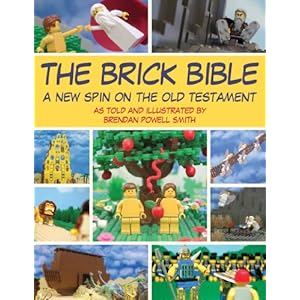
I missed the announcement before, but Brendan Powell Smith is coming out with a new Brick Testament Book, that will cover a large chunk of the Old Testament.
He's also posted some new chapters from Genesis (or are these remakes of previous chapters? I don't remember for sure). Today let's look at the first two:
Isaac Marries Rebekah - As always with Brendan these are very well done, and he uses new figures and torsos that weren't available to him when he last covered this part of Genesis. My favorite build detail is how he made kneeling camels. I also like how he came up with 4 different sizes of children in Gen 25:1-3.

Isaac Deceives Abimelech (aka 'Ah, Abimelech, will you never learn?') - He highlights the humor in that this is largely a rehash of a previous event. The combination of various white and blue elements is really cool, as is the perspective in this scene.

He's also posted some new chapters from Genesis (or are these remakes of previous chapters? I don't remember for sure). Today let's look at the first two:
Isaac Marries Rebekah - As always with Brendan these are very well done, and he uses new figures and torsos that weren't available to him when he last covered this part of Genesis. My favorite build detail is how he made kneeling camels. I also like how he came up with 4 different sizes of children in Gen 25:1-3.
Isaac Deceives Abimelech (aka 'Ah, Abimelech, will you never learn?') - He highlights the humor in that this is largely a rehash of a previous event. The combination of various white and blue elements is really cool, as is the perspective in this scene.
Friday, May 6, 2011
Friday
And God said, Let the earth bring forth the living creature after his kind, cattle, and creeping thing, and beast of the earth after his kind: and it was so. And God made the beast of the earth after his kind, and cattle after their kind, and every thing that creepeth upon the earth after his kind: and God saw that it was good. And God said, Let us make man in our image, after our likeness: and let them have dominion over the fish of the sea, and over the fowl of the air, and over the cattle, and over all the earth, and over every creeping thing that creepeth upon the earth. So God created man in his own image, in the image of God created he him; male and female created he them. And God blessed them, and God said unto them, Be fruitful, and multiply, and replenish the earth, and subdue it: and have dominion over the fish of the sea, and over the fowl of the air, and over every living thing that moveth upon the earth. And God said, Behold, I have given you every herb bearing seed, which is upon the face of all the earth, and every tree, in the which is the fruit of a tree yielding seed; to you it shall be for meat. And to every beast of the earth, and to every fowl of the air, and to every thing that creepeth upon the earth, wherein there is life, I have given every green herb for meat: and it was so. And God saw every thing that he had made, and, behold, it was very good. And the evening and the morning were the sixth day. - Genesis 1:24-31
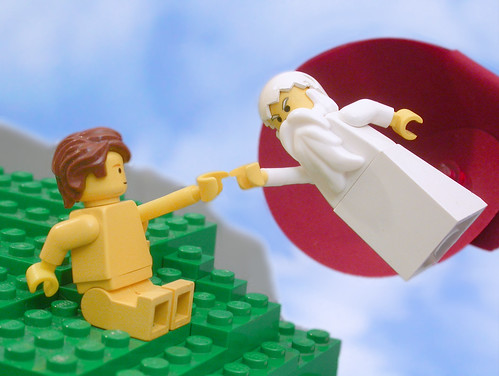
Since Alyska hasn't yet made the sixth window in her Creation series, I figured I'd finish up the week with Brendan Powell Smith's rendition of Michelangelo's Creation of Adam.
Since Alyska hasn't yet made the sixth window in her Creation series, I figured I'd finish up the week with Brendan Powell Smith's rendition of Michelangelo's Creation of Adam.
Sunday, March 13, 2011
Babel 3
Okay, one more take on the Babel story. Of course, Brendan Powell Smith has a great version of the Tower of Babel in the Brick Testament.

Saturday, December 11, 2010
Interview with Brendan, part 2
This is the continuation of an interview with Brendan Powell Smith, creator of the
Brick Testament. Please also read part 1 of the interview.
GodBricks: Currently you've been going back and recovering some of the stories that you addressed earlier, either expanding them or bringing in more advanced building techniques. How do you balance this versus addressing other parts of the Bible you have yet to cover?
Brendan Powell Smith: I ache to return to illustrating parts of the Bible that I have not yet covered at all. But the ache I felt when looking at my earliest illustrative work was worse, so it has won out for the past several months. I assume many people who come to The Brick Testament start with the beginning of Genesis, and I was just really bothered that my best work was not what people saw when they first visited.

So I feel committed to this re-illustration project for a while. I am not sure where I'll be able to draw the line and feel OK leaving the old stuff there. I kind of want to re-do all of Exodus and The Wilderness, though I know that's crazy. And I think I want to get to new material more than I want to spruce up those sections. Maybe. Haven't decided yet. Definitely have to at least close out the Abraham stories for consistency's sake, and I will very likely do a bit more work on the latter half of Genesis.
GB: Much of what you've done has been fairly straight-forward narrative. Some sections, though, have been less linear storytelling, like the law and the epistles, or used fantastic imagery like Revelation. Of course there's a ton of more poetic material you've left largely untouched, like the Psalms, Proverbs, and the major and minor prophets. Do you plan on tackling these areas? What additional challenges might these pose to you as an illustrator?
BPS: I would definitely like to illustrate a fair amount of material from Psalms, Proverbs, and the writings of the books of the Prophets.

I think people have a very misguided idea that the Psalms are a "nice" section of the Bible because they have heard Psalm 23 and assume they are all poetic praises of how good God is to people. I think this stands in need of correction.
GB: Do you have a favorite scene or MOC from the Brick Testament so far?
BPS: I am particularly proud of how I captured the insanity and horribleness of Revelation, whether it's the fiery balls of blood and hail that burn up a third of the Earth, or all the islands sinking into the sea and people attempting to kill themselves to avoid being tortured by locust creatures with scorpion tails, people worshiping a seven-headed beast from the sea, or Jesus trampling people to death in a giant, gory wine press.

I waited seven years to illustrate Revelation, because I knew my skills needed to be well-honed first, and I think that strategy was the right approach.
GB: Is there a particular scene or MOC that was particularly difficult to build in LEGO form?
BPS: Solomon's Temple took a lot of planning and patience to build inside and out. More recently I remember spending an enormous amount of time setting up a single shot of the victims of The Flood drowning in a watery grave. For the latter, I used a bunch of LEGO-constructed props to hold all the people and animals in place.

The supports themselves I hid off-camera, behind other people or animals, or had to resort to photoshopping out. It's the same technique I had used for the Battle in Heaven scene in Revelation.
GB: As I recall, there were already other niche books aimed at the AFOL community (things like books on Mindstorms programming), but The Brick Testament: Stories from the Book of Genesis was probably the first AFOL-produced book intended for a wider audience. There have since been others, like I LEGO NY, LEGO a Love Story, and the books by Sean Kenney. Were there any obstacles to getting a LEGO book published? Do you have any suggestions for others who would like to turn their hobby into a book?
BPS: The hardest thing is to find a publisher who is as excited about your idea as you are. After the first major press that The Brick Testament got, several people suggested I try to get a book published. I had a friend of a friend in the industry, and got a recommendation for an agent who could shop the book idea around for me. There was a certain amount of interest, but nothing came of it, so I assumed that was that. Then a few months later after some more good press, the president of a small publishing house happened to hear me interviewed on NPR and contacted me, and that turned into a three book series.


So it's hard to know how to give good advice. Make something new and awesome with wide appeal, and things will possibly work out for you.
GB: Do you think you'll ever finish this project? I don't mean will you build a MOC for every single verse in the Bible, but do you think you'll get to a point where you've illustrated all of the passages that interest you? Or perhaps will you simply get sick of this whole project? If so, do you have other projects in mind for the future? Perhaps your take on holy books from other religious traditions?
BPS: I don't know if I'll ever feel done with it, and I'm fine with that. It's nice to have a project I can just keep adding to and improving on indefinitely. Even if, in a few years from now, I've actually gotten around to illustrating all the Bible material I'm interested in illustrating, I wonder if I'll always feel compelled to go back and do a better job re-illustrating the oldest parts of the site. Even if my building, photography, and storytelling skills plateau at some level, it seems as though LEGO will always be putting out a wider and wider variety of minifig faces, hairstyles, outfitting, and accessories that I will wish I had had when I first illustrated a certain story. Or when I illustrated it the second or third time. :)
If I'm not at all sick of the project after nine years, it's hard to imagine that will ever happen, but who can know for sure? There's always the possibility of starting in on a new holy book after finishing the Bible, but I don't feel like I'm nearly as studied in other religions, so it would take a fair amount of groundwork first. I've started reading the Book of Mormon, but haven't gotten all that far, and don't like that it apes the writing style of the King James Bible, making it difficult to follow. I could get interested in illustrating some of the New Testament apocrypha, like the Acts of Thomas it which Jesus's twin goes to India, or the Apocalypse of Paul in which the apostle Paul gets a gruesome and detailed tour of the tortures of Hell.

But I if I had to pick one thing right now, I am most tempted to illustrate the works of Josephus concerning the Jewish-Roman war of 66-70 AD. It is chock full of great little stories very reminiscent of those in the Bible, and in some ways feels like a continuation of the epic story of the Israelites that the Bible begins in 4,000 BC and carries up to about 60 AD. So it's sort of a nice Bible epilogue or final act. And it's just as violent and terrible, but almost definitely more true.
GB: Okay, I'll let you get back to your bricks. Thanks for joining us here at GodBricks!
BPS: OK, back to building! Thanks for the thoughtful questions, and as always, thank you for your continued interest and support.
--
I hope that you enjoyed this new feature here at GodBricks. In the weeks and months to come I plan to have additional interviews with builders with different perspectives on the intersection between LEGO and religion.
Brick Testament. Please also read part 1 of the interview.
GodBricks: Currently you've been going back and recovering some of the stories that you addressed earlier, either expanding them or bringing in more advanced building techniques. How do you balance this versus addressing other parts of the Bible you have yet to cover?
Brendan Powell Smith: I ache to return to illustrating parts of the Bible that I have not yet covered at all. But the ache I felt when looking at my earliest illustrative work was worse, so it has won out for the past several months. I assume many people who come to The Brick Testament start with the beginning of Genesis, and I was just really bothered that my best work was not what people saw when they first visited.
So I feel committed to this re-illustration project for a while. I am not sure where I'll be able to draw the line and feel OK leaving the old stuff there. I kind of want to re-do all of Exodus and The Wilderness, though I know that's crazy. And I think I want to get to new material more than I want to spruce up those sections. Maybe. Haven't decided yet. Definitely have to at least close out the Abraham stories for consistency's sake, and I will very likely do a bit more work on the latter half of Genesis.
GB: Much of what you've done has been fairly straight-forward narrative. Some sections, though, have been less linear storytelling, like the law and the epistles, or used fantastic imagery like Revelation. Of course there's a ton of more poetic material you've left largely untouched, like the Psalms, Proverbs, and the major and minor prophets. Do you plan on tackling these areas? What additional challenges might these pose to you as an illustrator?
BPS: I would definitely like to illustrate a fair amount of material from Psalms, Proverbs, and the writings of the books of the Prophets.
I think people have a very misguided idea that the Psalms are a "nice" section of the Bible because they have heard Psalm 23 and assume they are all poetic praises of how good God is to people. I think this stands in need of correction.
GB: Do you have a favorite scene or MOC from the Brick Testament so far?
BPS: I am particularly proud of how I captured the insanity and horribleness of Revelation, whether it's the fiery balls of blood and hail that burn up a third of the Earth, or all the islands sinking into the sea and people attempting to kill themselves to avoid being tortured by locust creatures with scorpion tails, people worshiping a seven-headed beast from the sea, or Jesus trampling people to death in a giant, gory wine press.
I waited seven years to illustrate Revelation, because I knew my skills needed to be well-honed first, and I think that strategy was the right approach.
GB: Is there a particular scene or MOC that was particularly difficult to build in LEGO form?
BPS: Solomon's Temple took a lot of planning and patience to build inside and out. More recently I remember spending an enormous amount of time setting up a single shot of the victims of The Flood drowning in a watery grave. For the latter, I used a bunch of LEGO-constructed props to hold all the people and animals in place.


The supports themselves I hid off-camera, behind other people or animals, or had to resort to photoshopping out. It's the same technique I had used for the Battle in Heaven scene in Revelation.
GB: As I recall, there were already other niche books aimed at the AFOL community (things like books on Mindstorms programming), but The Brick Testament: Stories from the Book of Genesis was probably the first AFOL-produced book intended for a wider audience. There have since been others, like I LEGO NY, LEGO a Love Story, and the books by Sean Kenney. Were there any obstacles to getting a LEGO book published? Do you have any suggestions for others who would like to turn their hobby into a book?
BPS: The hardest thing is to find a publisher who is as excited about your idea as you are. After the first major press that The Brick Testament got, several people suggested I try to get a book published. I had a friend of a friend in the industry, and got a recommendation for an agent who could shop the book idea around for me. There was a certain amount of interest, but nothing came of it, so I assumed that was that. Then a few months later after some more good press, the president of a small publishing house happened to hear me interviewed on NPR and contacted me, and that turned into a three book series.
So it's hard to know how to give good advice. Make something new and awesome with wide appeal, and things will possibly work out for you.
GB: Do you think you'll ever finish this project? I don't mean will you build a MOC for every single verse in the Bible, but do you think you'll get to a point where you've illustrated all of the passages that interest you? Or perhaps will you simply get sick of this whole project? If so, do you have other projects in mind for the future? Perhaps your take on holy books from other religious traditions?
BPS: I don't know if I'll ever feel done with it, and I'm fine with that. It's nice to have a project I can just keep adding to and improving on indefinitely. Even if, in a few years from now, I've actually gotten around to illustrating all the Bible material I'm interested in illustrating, I wonder if I'll always feel compelled to go back and do a better job re-illustrating the oldest parts of the site. Even if my building, photography, and storytelling skills plateau at some level, it seems as though LEGO will always be putting out a wider and wider variety of minifig faces, hairstyles, outfitting, and accessories that I will wish I had had when I first illustrated a certain story. Or when I illustrated it the second or third time. :)
If I'm not at all sick of the project after nine years, it's hard to imagine that will ever happen, but who can know for sure? There's always the possibility of starting in on a new holy book after finishing the Bible, but I don't feel like I'm nearly as studied in other religions, so it would take a fair amount of groundwork first. I've started reading the Book of Mormon, but haven't gotten all that far, and don't like that it apes the writing style of the King James Bible, making it difficult to follow. I could get interested in illustrating some of the New Testament apocrypha, like the Acts of Thomas it which Jesus's twin goes to India, or the Apocalypse of Paul in which the apostle Paul gets a gruesome and detailed tour of the tortures of Hell.
But I if I had to pick one thing right now, I am most tempted to illustrate the works of Josephus concerning the Jewish-Roman war of 66-70 AD. It is chock full of great little stories very reminiscent of those in the Bible, and in some ways feels like a continuation of the epic story of the Israelites that the Bible begins in 4,000 BC and carries up to about 60 AD. So it's sort of a nice Bible epilogue or final act. And it's just as violent and terrible, but almost definitely more true.
GB: Okay, I'll let you get back to your bricks. Thanks for joining us here at GodBricks!
BPS: OK, back to building! Thanks for the thoughtful questions, and as always, thank you for your continued interest and support.
--
I hope that you enjoyed this new feature here at GodBricks. In the weeks and months to come I plan to have additional interviews with builders with different perspectives on the intersection between LEGO and religion.
Thursday, December 2, 2010
Interview with Brendan, part 1
As a new feature here at GodBricks, I'm going to have occasional interviews with some of the LEGO builders I've featured. And who better to start with than Brendan Powell Smith, creator of The Brick Testament? This work is easily the most extensive and most prominent LEGO project devoted to themes relevant to this blog, but from a different perspective. Since Brendan was kind enough to give extended answers to several of my questions, I'm going to break this up into two parts. And so, with no further ado, on to the interview ...

Photo credit goes to Flak Magazine.
GodBricks: First up, welcome to GodBricks. For the sake of our readers, let me say up front that we've corresponded many times and I've been a fan of the Brick Testament from the very beginning nine years ago. Can you tell me about the original inspiration of this project? Did you intend from the very start to spend many years covering the whole Bible, or was this at first just meant to be a few short stories and then on to other LEGO projects?
Brendan Powell Smith: The Brick Testament began life as just another in a string of quirky creative projects I was doing at the time (others included writing and recording albums, making a 600-page web-based choose-your-own-adventure game, and writing and acting in a Christmas movie). To be honest, if any of those projects had gotten the kind of attention and flattering praise that The Brick Testament attracted so quickly, I might still be working on one of those other projects.
When I first conceived of doing the Bible in LEGO, my initial thought was to just recreate a few famous scenes like the Garden of Eden and the Last Supper as LEGO models. But as I started building the Garden and designing minifigure versions of Adam, Eve, and God, I began to realize that I had an opportunity to make not just models for display, but that I could retell the stories of the Bible in LEGO using a series of still photos set inside a fully LEGO-built universe.

Since I was starting with the first story from the first book of the Bible, I thought I'd just go from there and see how things went. The website went online in October 2001 with six stories, from Adam and Eve up to The Flood. Things indeed went well, and now, nine years later, I've put 422 illustrated Bible stories on the website and have had three books published in seven languages around the world.
GB: I know that you are not a religious person. Could you tell us about your own story with regards to faith issues? Why would someone who is not religious spend so much time on the Bible?
BPS: I was raised in a family that went to an Episcopal church where my mom was even a Sunday School teacher for a few years. Around the age of thirteen, I went through a phase where I consciously decided I wanted to leave behind what seemed like childish ways of thinking. I didn't start off taking aim at religion. It was more an attempt to weed out magical thinking and superstition, but eventually I began to see the similarities in how people think about God and especially prayer. It wasn't the most comfortable thing for me to bring skepticism to bear against God at that age, and it was a solitary journey, since I did not know anyone else who was not a believing Christian. But I baby-stepped my way through it with thoughts like, "Well, if there is a God, and he is going to punish me for even questioning these sorts of things, that doesn't seem like a God worthy of my respect in the first place."

Eventually I decided there just did not seem to be good reasons to believe in God, and that it seemed far more likely that no gods exist, and that put me in an odd position. I now felt like I had "seen through" religion, and that I had figured out something that almost everyone else in the world had not, even people who were (otherwise) very, very sharp. This made me fascinated by religion and with why other people found it convincing and didn't see through it the way I did. Was it that I was missing something, or was it really that almost everyone else was?
This curiosity lead me to study religion and philosophy in college, where I learned about the historical origins of Judaism and Christianity, studied the philosophical arguments for and against the existence of God, and first read through the Bible on my own. Reading the Bible was a revelation to me. I was downright shocked by so much of the content and by the overall portrait it portrayed of God. It seemed entirely at odds with the idea of God that most Christians I'd encountered seemed to believe in. I became convinced that most people simply are not aware of the contents of the Bible, and reasoned that it would be a better thing if they were.
So even though I am not religious, I recognize the importance of people being familiar with the contents of the Bible, and I am jarred by the idea that more than 2 billion people identify themselves as Christians or Jews, and yet almost none of them really know what makes up the vast bulk of the book they consider our most important moral guide. The few carefully chosen readings given in churches, and the distorted versions the Bible stories found in children's Bibles and Sunday School lessons were not doing the job, and were actually giving people a false representation of the Bible. So I wondered if there was a way to make the actual contents of the Bible presentable in a way that was fun and engaging, and yet still true to the text. It wasn't until a few years out of college, though, that I happened to get back into building with LEGO as an adult.
GB: Have your own views of the Bible, Christianity, or Judaism changed in any way over the course of this project?
BPS: There are a couple of things I've changed my mind about over the years. One of them is the conventional wisdom that says "The God of the Old Testament is god of wrath, while the God of the New Testament is a god of love". To some degree I believed something akin to this for years even after I'd been working on The Brick Testament, though I wouldn't have made the contrast quite so stark. Sure, it's easier to find some more agreeable or even noble ethical maxims in the Gospels, but the life and teachings of Jesus are not without their dark side, and even within the first year of working on The Brick Testament, I made sure to strike a balance between adding material from the New Testament in proportion to material from the Old Testament. I've always sought to keep The Brick Testament safe from the potential criticism that it only highlights some small minority of Biblical material that misrepresents the whole.
It was in re-reading the book of Revelation, though, that it became clear to me that the God of the New Testament was every bit as much a nasty, vengeful God of wrath as the God of the Old Testament. My mind reeled at the sadistic nature of that book, and how warped by hatred and spite its author must have been. It casts a deep, dark shadow over anything positive that might have come before it in the pages of the New Testament, and yet seems in many ways like a perfect close to a Bible whose bulk concerns the God of the Old Testament.

The other change of mind I've had over the years concerns the scholarly quest for the historical Jesus. I studied under Paula Fredriksen at Boston University, and for many years after that I found her view of the historical Jesus to be the most convincing. It is the same view held by consensus of (non-religiously-motivated) scholars, and perhaps best laid out by Bart Ehrman in his 1999 book Jesus: Apocalyptic Prophet of the New Millenium. As that title suggests, these scholars argue that the evidence points to a portrait of Jesus as a Jewish prophet (one of many during that period) who was convinced that God was about to (during his lifetime) bring about a violent end to the world and usher in a radically new age. His code of ethics are therefore best understood as temporary instructions on how to act during the very, very short time remaining.
What's changed for me is that, while I still think scholars like Ehrman and Fredriksen make a strong argument, I have become more persuaded by the interpretation of the evidence by the author Earl Doherty who, in his book Jesus: Neither God Nor Man, makes the argument that the writings of the first hundred years of Christianity point to an earliest period of the religion that believed in a Jesus / Son of God figure who was purely a spiritual entity, and who was not seen as a human being who had walked the Earth in recent memory. I fully realize this theory strikes most people as a radical notion, and those who haven't read the case for it are quick to dismiss it. In fact, I would even recommend that people read Ehrman's or Fredriksen's books first, since they are a bit more accessible, and provide a good groundwork for comparison. And yet, in the end, I find Doherty theoy has the most explanatory power, leaving fewer important questions unresolved.
But my own assessment of the scholarly quest for the historical Jesus does not really affect my work on The Brick Testament in any significant way. When illustrating the Bible, I always put myself in the mindset that what it says about Jesus it true. It would be the same if I were illustrating The Illiad: even if I was interested in Ancient Greek history enough to become convinced, like most scholars, that King Agamemnon was not an actual historical king of Mycenae, such a belief would not change how I illustrated Homer's epic.
GB: Of course you've gotten tons of press over the years. Can you tell us about some of the response you've gotten from different groups - atheists/agnostics, Christians, Jews, Muslims, The LEGO Group?
BPS: The vast majority of responses I've received have been very positive, whether from Christians, Jews, or non-religious folks. There have been hundreds of requests from churches and other religious institutions to use material from The Brick Testament their in presentations and classes. Others who have left the religion they were brought up in tend to appreciate how it brings to light the absurdities and repugnant material in the Bible.
Only about one in every hundred e-mails will have anything negative to say. The most common complaint is that I do not shy away from illustrating the Bible's sexual content in a frank manner, and there is an accompanying worry over the effect that seeing such things might have on children. I am always bewildered that people could be so worried about children being exposed to sexual content, yet not have a far more pressing concern over children being exposed to cruel and violent content. Especially when it comes to the Bible where, sure, there is a little bit of sex content here or there, but the amount of cruel and violent material is just tremendous. It is by far the most violent book I have ever read. I can't understand how someone could fear the effects of children seeing a depiction of two people having sex more than they would fear the effects of children seeing a depiction of torture, murder, or genocide.

I don't know what the reaction of The LEGO Group is to The Brick Testament. I know that there are people who work for LEGO who are fans and have said some very nice things about the project, but I think the company itself would prefer to keep a polite distance, and that's fine with me. While it would be wonderful to get shipments free bricks from them (especially any and all new minifig parts as they come out, wouldn't that be nice?), I don't think they would ever want to be seen as a sponsor of the site, or endorsers of its content, and I would never want to feel beholden to them when it comes to making decisions about its content.
GB: I note Muslims in particular because someone took an image out of context and labeled it as Muhammad having sex. Your depiction of slavery is another image I've seen spread around the web without proper attribution or context. I rather suspect that your depiction of Nazis will eventually share a similar fate. Have you had any personal fallout from things like this? Have you tried to counter this misuse of your images?
BPS: I don't know that I've ever received feedback about The Brick Testament from someone who made clear that they are a believing Muslim. I am aware of the image that was taken from the Judges section of my website and altered by some unknown person (without my knowledge or permission) to depict a fake LEGO set of Mohammed having sex with an underage girl. It had spread to many parts of the internet before it came to my attention. I did make a concerted effort to post a note on any forum or blog that displayed this image, asking them to remove it, and explaining how the original had been altered without my consent. I suppose it's possible for any of my images to get used without my permission in a similar way. If someone can take an image of an Israelite and label it Mohammed, perhaps someone will take the image of the Nazi rally and label it a kibbutz.

I have not had any personal fallout from anything like this so far. Of course, it will be a shame if a Muslim believer kills me because he mistakenly believes I depicted Muhammad in LEGO. But I'm not sure what I could really do to prevent that. That whole issue is pretty insane. Does it make any sense for people to be "tolerant" of the insane and evil belief that someone should die for depicting a certain other person? If Presbyterians believed that people should be killed for wearing blue jeans, and indeed had killed many people who wore blue jeans, should other people show "respect" for that belief and never wear blue jeans? Wouldn't the more sensible thing be to denounce such evil, deranged beliefs and severely punish anyone who acted on them?
A huge thank you to Brendan. Check back in a couple of days for part two of this interview. -GodBrick
Edit - Please read part 2 of the interview.
Photo credit goes to Flak Magazine.
GodBricks: First up, welcome to GodBricks. For the sake of our readers, let me say up front that we've corresponded many times and I've been a fan of the Brick Testament from the very beginning nine years ago. Can you tell me about the original inspiration of this project? Did you intend from the very start to spend many years covering the whole Bible, or was this at first just meant to be a few short stories and then on to other LEGO projects?
Brendan Powell Smith: The Brick Testament began life as just another in a string of quirky creative projects I was doing at the time (others included writing and recording albums, making a 600-page web-based choose-your-own-adventure game, and writing and acting in a Christmas movie). To be honest, if any of those projects had gotten the kind of attention and flattering praise that The Brick Testament attracted so quickly, I might still be working on one of those other projects.
When I first conceived of doing the Bible in LEGO, my initial thought was to just recreate a few famous scenes like the Garden of Eden and the Last Supper as LEGO models. But as I started building the Garden and designing minifigure versions of Adam, Eve, and God, I began to realize that I had an opportunity to make not just models for display, but that I could retell the stories of the Bible in LEGO using a series of still photos set inside a fully LEGO-built universe.
Since I was starting with the first story from the first book of the Bible, I thought I'd just go from there and see how things went. The website went online in October 2001 with six stories, from Adam and Eve up to The Flood. Things indeed went well, and now, nine years later, I've put 422 illustrated Bible stories on the website and have had three books published in seven languages around the world.
GB: I know that you are not a religious person. Could you tell us about your own story with regards to faith issues? Why would someone who is not religious spend so much time on the Bible?
BPS: I was raised in a family that went to an Episcopal church where my mom was even a Sunday School teacher for a few years. Around the age of thirteen, I went through a phase where I consciously decided I wanted to leave behind what seemed like childish ways of thinking. I didn't start off taking aim at religion. It was more an attempt to weed out magical thinking and superstition, but eventually I began to see the similarities in how people think about God and especially prayer. It wasn't the most comfortable thing for me to bring skepticism to bear against God at that age, and it was a solitary journey, since I did not know anyone else who was not a believing Christian. But I baby-stepped my way through it with thoughts like, "Well, if there is a God, and he is going to punish me for even questioning these sorts of things, that doesn't seem like a God worthy of my respect in the first place."
Eventually I decided there just did not seem to be good reasons to believe in God, and that it seemed far more likely that no gods exist, and that put me in an odd position. I now felt like I had "seen through" religion, and that I had figured out something that almost everyone else in the world had not, even people who were (otherwise) very, very sharp. This made me fascinated by religion and with why other people found it convincing and didn't see through it the way I did. Was it that I was missing something, or was it really that almost everyone else was?
This curiosity lead me to study religion and philosophy in college, where I learned about the historical origins of Judaism and Christianity, studied the philosophical arguments for and against the existence of God, and first read through the Bible on my own. Reading the Bible was a revelation to me. I was downright shocked by so much of the content and by the overall portrait it portrayed of God. It seemed entirely at odds with the idea of God that most Christians I'd encountered seemed to believe in. I became convinced that most people simply are not aware of the contents of the Bible, and reasoned that it would be a better thing if they were.
So even though I am not religious, I recognize the importance of people being familiar with the contents of the Bible, and I am jarred by the idea that more than 2 billion people identify themselves as Christians or Jews, and yet almost none of them really know what makes up the vast bulk of the book they consider our most important moral guide. The few carefully chosen readings given in churches, and the distorted versions the Bible stories found in children's Bibles and Sunday School lessons were not doing the job, and were actually giving people a false representation of the Bible. So I wondered if there was a way to make the actual contents of the Bible presentable in a way that was fun and engaging, and yet still true to the text. It wasn't until a few years out of college, though, that I happened to get back into building with LEGO as an adult.
GB: Have your own views of the Bible, Christianity, or Judaism changed in any way over the course of this project?
BPS: There are a couple of things I've changed my mind about over the years. One of them is the conventional wisdom that says "The God of the Old Testament is god of wrath, while the God of the New Testament is a god of love". To some degree I believed something akin to this for years even after I'd been working on The Brick Testament, though I wouldn't have made the contrast quite so stark. Sure, it's easier to find some more agreeable or even noble ethical maxims in the Gospels, but the life and teachings of Jesus are not without their dark side, and even within the first year of working on The Brick Testament, I made sure to strike a balance between adding material from the New Testament in proportion to material from the Old Testament. I've always sought to keep The Brick Testament safe from the potential criticism that it only highlights some small minority of Biblical material that misrepresents the whole.
It was in re-reading the book of Revelation, though, that it became clear to me that the God of the New Testament was every bit as much a nasty, vengeful God of wrath as the God of the Old Testament. My mind reeled at the sadistic nature of that book, and how warped by hatred and spite its author must have been. It casts a deep, dark shadow over anything positive that might have come before it in the pages of the New Testament, and yet seems in many ways like a perfect close to a Bible whose bulk concerns the God of the Old Testament.
The other change of mind I've had over the years concerns the scholarly quest for the historical Jesus. I studied under Paula Fredriksen at Boston University, and for many years after that I found her view of the historical Jesus to be the most convincing. It is the same view held by consensus of (non-religiously-motivated) scholars, and perhaps best laid out by Bart Ehrman in his 1999 book Jesus: Apocalyptic Prophet of the New Millenium. As that title suggests, these scholars argue that the evidence points to a portrait of Jesus as a Jewish prophet (one of many during that period) who was convinced that God was about to (during his lifetime) bring about a violent end to the world and usher in a radically new age. His code of ethics are therefore best understood as temporary instructions on how to act during the very, very short time remaining.
What's changed for me is that, while I still think scholars like Ehrman and Fredriksen make a strong argument, I have become more persuaded by the interpretation of the evidence by the author Earl Doherty who, in his book Jesus: Neither God Nor Man, makes the argument that the writings of the first hundred years of Christianity point to an earliest period of the religion that believed in a Jesus / Son of God figure who was purely a spiritual entity, and who was not seen as a human being who had walked the Earth in recent memory. I fully realize this theory strikes most people as a radical notion, and those who haven't read the case for it are quick to dismiss it. In fact, I would even recommend that people read Ehrman's or Fredriksen's books first, since they are a bit more accessible, and provide a good groundwork for comparison. And yet, in the end, I find Doherty theoy has the most explanatory power, leaving fewer important questions unresolved.
But my own assessment of the scholarly quest for the historical Jesus does not really affect my work on The Brick Testament in any significant way. When illustrating the Bible, I always put myself in the mindset that what it says about Jesus it true. It would be the same if I were illustrating The Illiad: even if I was interested in Ancient Greek history enough to become convinced, like most scholars, that King Agamemnon was not an actual historical king of Mycenae, such a belief would not change how I illustrated Homer's epic.
GB: Of course you've gotten tons of press over the years. Can you tell us about some of the response you've gotten from different groups - atheists/agnostics, Christians, Jews, Muslims, The LEGO Group?
BPS: The vast majority of responses I've received have been very positive, whether from Christians, Jews, or non-religious folks. There have been hundreds of requests from churches and other religious institutions to use material from The Brick Testament their in presentations and classes. Others who have left the religion they were brought up in tend to appreciate how it brings to light the absurdities and repugnant material in the Bible.
Only about one in every hundred e-mails will have anything negative to say. The most common complaint is that I do not shy away from illustrating the Bible's sexual content in a frank manner, and there is an accompanying worry over the effect that seeing such things might have on children. I am always bewildered that people could be so worried about children being exposed to sexual content, yet not have a far more pressing concern over children being exposed to cruel and violent content. Especially when it comes to the Bible where, sure, there is a little bit of sex content here or there, but the amount of cruel and violent material is just tremendous. It is by far the most violent book I have ever read. I can't understand how someone could fear the effects of children seeing a depiction of two people having sex more than they would fear the effects of children seeing a depiction of torture, murder, or genocide.
I don't know what the reaction of The LEGO Group is to The Brick Testament. I know that there are people who work for LEGO who are fans and have said some very nice things about the project, but I think the company itself would prefer to keep a polite distance, and that's fine with me. While it would be wonderful to get shipments free bricks from them (especially any and all new minifig parts as they come out, wouldn't that be nice?), I don't think they would ever want to be seen as a sponsor of the site, or endorsers of its content, and I would never want to feel beholden to them when it comes to making decisions about its content.
GB: I note Muslims in particular because someone took an image out of context and labeled it as Muhammad having sex. Your depiction of slavery is another image I've seen spread around the web without proper attribution or context. I rather suspect that your depiction of Nazis will eventually share a similar fate. Have you had any personal fallout from things like this? Have you tried to counter this misuse of your images?
BPS: I don't know that I've ever received feedback about The Brick Testament from someone who made clear that they are a believing Muslim. I am aware of the image that was taken from the Judges section of my website and altered by some unknown person (without my knowledge or permission) to depict a fake LEGO set of Mohammed having sex with an underage girl. It had spread to many parts of the internet before it came to my attention. I did make a concerted effort to post a note on any forum or blog that displayed this image, asking them to remove it, and explaining how the original had been altered without my consent. I suppose it's possible for any of my images to get used without my permission in a similar way. If someone can take an image of an Israelite and label it Mohammed, perhaps someone will take the image of the Nazi rally and label it a kibbutz.
I have not had any personal fallout from anything like this so far. Of course, it will be a shame if a Muslim believer kills me because he mistakenly believes I depicted Muhammad in LEGO. But I'm not sure what I could really do to prevent that. That whole issue is pretty insane. Does it make any sense for people to be "tolerant" of the insane and evil belief that someone should die for depicting a certain other person? If Presbyterians believed that people should be killed for wearing blue jeans, and indeed had killed many people who wore blue jeans, should other people show "respect" for that belief and never wear blue jeans? Wouldn't the more sensible thing be to denounce such evil, deranged beliefs and severely punish anyone who acted on them?
A huge thank you to Brendan. Check back in a couple of days for part two of this interview. -GodBrick
Edit - Please read part 2 of the interview.
Tuesday, October 26, 2010
Genesis
I've been very remiss in covering recent additions to The Brick Testament. Brendan has been systematically going back and rebuilding or adding to stories from Genesis. Personally, I'd like to see him take on some of the material he hasn't already covered, particularly some of the less-narrative sections like the Psalms or the Prophets.

Abram Impregnates a Slave Girl tells the story of Sarai, Hagar and Ishmael. From a LEGO standpoint, I really like the scene above with the clever hammock design, the skateboard ramps forming the tent, the variety of molded and brick-built animals, and the implied action in the distance and around the edges. When the same scene is mirrored three scenes later, the look on Sarai's face is perfect. I've never been a huge fan of the 1x2 tile-as-pregnant-belly solution, but I don't know a better way to imply a pregnant minifig.

God Wants Part of Penis Cut Off tells about the initiation of circumcision. Some humorous scenes here with the looks on the faces of those being circumcised, and also lying down in the background. I'm not a fan of the dagger. I know, I know, it's an official piece from the Prince of Persia line, but it just doesn't look like LEGO to me.

God Drops By for a Meal tells of three strangers who pay a visit to Abram. Those palm trees in the distance are very simple and yet effective when in soft focus. The larger tree close to Abram's tent doesn't work as well when it is in sharp focus here as opposed to the soft focus seen in some of the earlier stories. I'm not sure if I like the molded dog modified to be a calf - I think that Brendan had a better brick-built calf design in the past. Kind of odd but humorous that God isn't facing Abram as he's talking to him while he eats.
Abram Impregnates a Slave Girl tells the story of Sarai, Hagar and Ishmael. From a LEGO standpoint, I really like the scene above with the clever hammock design, the skateboard ramps forming the tent, the variety of molded and brick-built animals, and the implied action in the distance and around the edges. When the same scene is mirrored three scenes later, the look on Sarai's face is perfect. I've never been a huge fan of the 1x2 tile-as-pregnant-belly solution, but I don't know a better way to imply a pregnant minifig.
God Wants Part of Penis Cut Off tells about the initiation of circumcision. Some humorous scenes here with the looks on the faces of those being circumcised, and also lying down in the background. I'm not a fan of the dagger. I know, I know, it's an official piece from the Prince of Persia line, but it just doesn't look like LEGO to me.
God Drops By for a Meal tells of three strangers who pay a visit to Abram. Those palm trees in the distance are very simple and yet effective when in soft focus. The larger tree close to Abram's tent doesn't work as well when it is in sharp focus here as opposed to the soft focus seen in some of the earlier stories. I'm not sure if I like the molded dog modified to be a calf - I think that Brendan had a better brick-built calf design in the past. Kind of odd but humorous that God isn't facing Abram as he's talking to him while he eats.
Tuesday, June 15, 2010
In the beginning . . .
Well, actually just back in 2001, Brendan Powell Smith started his Brick Testament project off with The Garden of Eden and five other illustrated stories from Genesis. He's gone back and redone this, breaking it into two parts: Creation and the Garden of Eden. Part of me asks why do this? Yes, there are many new elements that he uses here that were unavailable nine years ago, and Brendan's building has certainly improved over time, but those original scenes in Eden are so iconic to the Brick Testament that it seems they shouldn't have been touched (e.g. the scene with the Kaadu and Jar-Jar among the created animals). You can compare the old and the new on this page. And the original will always be with us in book form, so let's go on and look at these new iterations with fresh eyes.
Creation - Some nice bits in the start with the differences between dark and light and God lifting up the sky. Having God float over the creation scenes is a nice decision, presumably achieved via Photoshop layering. Genesis 1:10, the creation of land, is a great example of this. I'm really curious as to what piece is used for the sun here, some lid? And the moon and stars are great (and nice to bracket the story, as he uses a very similar technique in Revelations). Genesis 1:21 with the fish and birds is well done and along with Genesis 1:24-25, the creation of animals, shows how many more LEGO animals are available than when the Brick Testament began. Hey, there's the Kaadu! Now I'm happy again. Great new sheep design in 1:25. About the only non-LEGO aspect worth noting is 1:27, where God makes people, and Brendan chooses not to just make Adam and Eve, but a whole bunch of people. He comments on Flickr that he treated the Genesis 1 and 2 creation accounts separately, without trying to harmonize them. I do think it might have been better here to include racial diversity, with various flesh tone figs included, but perhaps there weren't blank torsos/hips/legs available in these other colors. The final scene, with God kicking back in a hammock on the seventh day, is priceless.

The Garden of Eden - This is generally well done and in keeping with the original version. I really like God building Adam up out of brown dirt, and then bringing him to life as a yellow fig. I'm really not a fan of the design of the Tree of the Knowledge of Good and Evil. I've tried using that stump element as the base for a tree before and come up short, and I'm afraid to say that Brendan's solution doesn't work for me here either. The Tree of Life, OTOH, has a very nice design. In 2:24, it's a little creepy to have God standing there while Adam and Eve get to know each other. In 3:7, I really like the way he's switched heads for Adam and Eve to the open-mouthed expressions, and then keeps these up for the next several scenes. Nice use of the brand new caveman torso for the newly clothed figs, and that last scene is great - especially the scraggly brown out-of-focus trees in the background.
By the way, Brendan also recreated Michelangelo's Creation of Adam, though it doesn't get used in either of these stories.
Creation - Some nice bits in the start with the differences between dark and light and God lifting up the sky. Having God float over the creation scenes is a nice decision, presumably achieved via Photoshop layering. Genesis 1:10, the creation of land, is a great example of this. I'm really curious as to what piece is used for the sun here, some lid? And the moon and stars are great (and nice to bracket the story, as he uses a very similar technique in Revelations). Genesis 1:21 with the fish and birds is well done and along with Genesis 1:24-25, the creation of animals, shows how many more LEGO animals are available than when the Brick Testament began. Hey, there's the Kaadu! Now I'm happy again. Great new sheep design in 1:25. About the only non-LEGO aspect worth noting is 1:27, where God makes people, and Brendan chooses not to just make Adam and Eve, but a whole bunch of people. He comments on Flickr that he treated the Genesis 1 and 2 creation accounts separately, without trying to harmonize them. I do think it might have been better here to include racial diversity, with various flesh tone figs included, but perhaps there weren't blank torsos/hips/legs available in these other colors. The final scene, with God kicking back in a hammock on the seventh day, is priceless.
The Garden of Eden - This is generally well done and in keeping with the original version. I really like God building Adam up out of brown dirt, and then bringing him to life as a yellow fig. I'm really not a fan of the design of the Tree of the Knowledge of Good and Evil. I've tried using that stump element as the base for a tree before and come up short, and I'm afraid to say that Brendan's solution doesn't work for me here either. The Tree of Life, OTOH, has a very nice design. In 2:24, it's a little creepy to have God standing there while Adam and Eve get to know each other. In 3:7, I really like the way he's switched heads for Adam and Eve to the open-mouthed expressions, and then keeps these up for the next several scenes. Nice use of the brand new caveman torso for the newly clothed figs, and that last scene is great - especially the scraggly brown out-of-focus trees in the background.
By the way, Brendan also recreated Michelangelo's Creation of Adam, though it doesn't get used in either of these stories.
Monday, May 24, 2010
LEGO: A Love Story
Hi. I'm posting a copy of this book review to each of my four blogs. However, if you read more than one of my blogs, I'm including a unique paragraph to the end on each blog noting specifics of the book relevant to the topic of that blog.
Review: A couple of years ago, I remember hearing on one of the LEGO forums about Jonathan Bender, a journalist who was planning on spending a year exploring the AFOL community as part of a writing project. He started a blog, Brick Bender, to document his journey. I read a few entries, but there are so many different blogs and websites out there that I kind of forgot about it. Recently, though, this exploration came to fruition in a new book, LEGO: A Love Story.
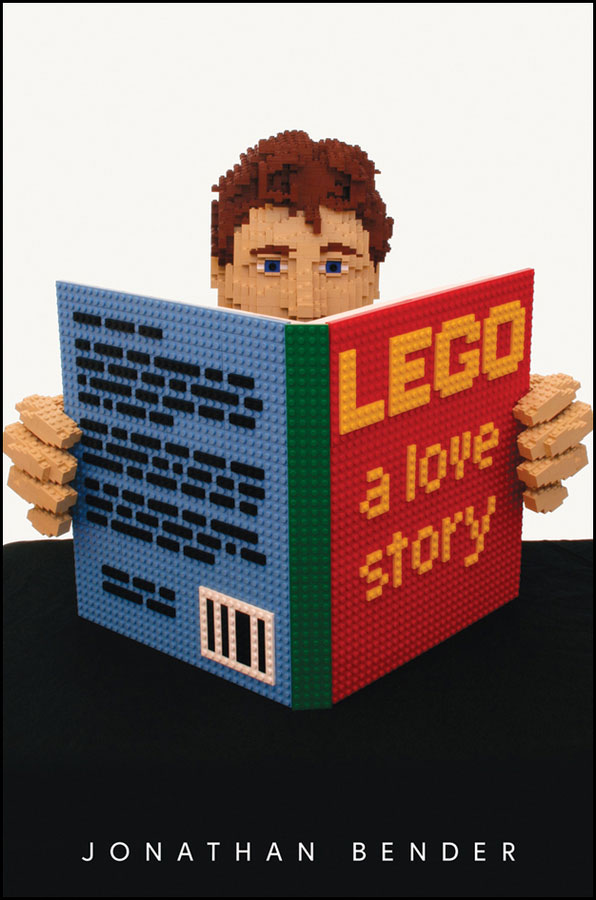
The result is a highly enjoyable book. Jonathan follows the journey that many of us took. He remembers playing with LEGO as a kid, but then goes into a long dark age. Little things remind him of his hobby, and eventually he digs his old bricks out of his parents' basement. He nervously buys new LEGO for himself, afraid that others might learn of his purchase. Then he starts building MOCs. He connects with the community, and is initially nervous that his MOCs won't measure up to the amazing models he sees.
Along the way, Jonathan met up with a great number of people from the AFOL community. One of the first things I noticed when flipping through the book was that it has a great index, and, yes, I looked myself up. To my utter surprise, delight, and honor, there I was. On page 106 he quotes something I posted on Lugnet several years ago about vignettes. But I'm a minor player, of course. He talks to a great number of the major players in the AFOL world, from bloggers to fest organizers, to current and former LEGO employees. He also researches the LEGO company and the growth of the fan community, with a lot of the major events along the way. He travels to several fan events like Brick World, Brick Bash, Brick Show, and BrickCon (hmm, see a pattern in fan fest names?) and gets behind the scenes tours at the Toy and Plastic Brick Museum, Legoland California, and the homeland itself, LEGO headquarters in Billund. And he invites us all along for the ride.
There are several audiences for this book. If you are just interested in the hobby as an outsider, particularly if you are, say, the spouse of an AFOL, he gives a great insight into these crazy people and their plastic brick masterpieces. If you are just coming out of your own dark age, you can learn a ton about the hobby and the people in it. If you're someone who's been in the hobby for years, it's like going to a reunion, where you encounter old friends and share great memories.
Are there shortcomings in this book? Yes, of course. No book can hope to be a comprehensive view of such a large and diverse community. I saw a couple of small errors, and places where I remember events a little differently than he reports. It felt in places like he gave a larger weight to some individuals because he got to know them personally, while other very important members of the community were missed, especially those outside the US. I do wish that he'd spent more time on the evolution of the on-line side of the Legoverse. He has a good picture of the growth from Usenet newsgroups to Lugnet. But as he reports, Lugnet is pretty dead these days, and he doesn't really go into the way that other, more specific forums grew out of Lugnet, or the variety of blogs (other than the Brothers Brick, which he rightly points out as the most important LEGO blog) and Flickr groups. The other thing I really felt the book needed was more pictures. There are black and white photos at the start of each chapter, and eight pages of glossy color photos in the center, but with such a visual medium you could have put photos on almost every page. As a pretty active AFOL I remember a lot of the different MOCs he mentions, but someone less involved in the hobby would benefit from photos of these. I want to reread the book with Jonathan's blog open in front of me, so that I can go back and forth and see his photos along with the events he describes.
The book is intensely personal. In addition to inviting us in to his own feelings as he becomes an AFOL - the fun of discovery, the nervousness about others learning about his hobby, the fear that his efforts would not be accepted by other AFOLs - he invites us deeper. We get to see him building LEGO with his dad as a child, and then again reconnecting through LEGO as an adult. Even more personally, we get his and his wife's fears that they may never have children of their own. I'm not afraid to admit that my eyes were tearing up at the emotional climax in the last few pages. This is ultimately a book about love. Yes, we all share a love for little plastic bricks, but in the end it is about love between people - the lasting friendships built up between community members, the love of a husband and wife, the love of a parent and child. That's what makes this hobby so special, and that's what this book celebrates.
GodBricks specific material: Jonathan has a discussion with Brendan Powell Smith about the Brick Testament. He also has a passing reference to these crosses produced by the LEGO company in their early years of molding plastic. He also talks with Brian Korte of Brickworkz, who has been featured here before.
Review: A couple of years ago, I remember hearing on one of the LEGO forums about Jonathan Bender, a journalist who was planning on spending a year exploring the AFOL community as part of a writing project. He started a blog, Brick Bender, to document his journey. I read a few entries, but there are so many different blogs and websites out there that I kind of forgot about it. Recently, though, this exploration came to fruition in a new book, LEGO: A Love Story.
The result is a highly enjoyable book. Jonathan follows the journey that many of us took. He remembers playing with LEGO as a kid, but then goes into a long dark age. Little things remind him of his hobby, and eventually he digs his old bricks out of his parents' basement. He nervously buys new LEGO for himself, afraid that others might learn of his purchase. Then he starts building MOCs. He connects with the community, and is initially nervous that his MOCs won't measure up to the amazing models he sees.
Along the way, Jonathan met up with a great number of people from the AFOL community. One of the first things I noticed when flipping through the book was that it has a great index, and, yes, I looked myself up. To my utter surprise, delight, and honor, there I was. On page 106 he quotes something I posted on Lugnet several years ago about vignettes. But I'm a minor player, of course. He talks to a great number of the major players in the AFOL world, from bloggers to fest organizers, to current and former LEGO employees. He also researches the LEGO company and the growth of the fan community, with a lot of the major events along the way. He travels to several fan events like Brick World, Brick Bash, Brick Show, and BrickCon (hmm, see a pattern in fan fest names?) and gets behind the scenes tours at the Toy and Plastic Brick Museum, Legoland California, and the homeland itself, LEGO headquarters in Billund. And he invites us all along for the ride.
There are several audiences for this book. If you are just interested in the hobby as an outsider, particularly if you are, say, the spouse of an AFOL, he gives a great insight into these crazy people and their plastic brick masterpieces. If you are just coming out of your own dark age, you can learn a ton about the hobby and the people in it. If you're someone who's been in the hobby for years, it's like going to a reunion, where you encounter old friends and share great memories.
Are there shortcomings in this book? Yes, of course. No book can hope to be a comprehensive view of such a large and diverse community. I saw a couple of small errors, and places where I remember events a little differently than he reports. It felt in places like he gave a larger weight to some individuals because he got to know them personally, while other very important members of the community were missed, especially those outside the US. I do wish that he'd spent more time on the evolution of the on-line side of the Legoverse. He has a good picture of the growth from Usenet newsgroups to Lugnet. But as he reports, Lugnet is pretty dead these days, and he doesn't really go into the way that other, more specific forums grew out of Lugnet, or the variety of blogs (other than the Brothers Brick, which he rightly points out as the most important LEGO blog) and Flickr groups. The other thing I really felt the book needed was more pictures. There are black and white photos at the start of each chapter, and eight pages of glossy color photos in the center, but with such a visual medium you could have put photos on almost every page. As a pretty active AFOL I remember a lot of the different MOCs he mentions, but someone less involved in the hobby would benefit from photos of these. I want to reread the book with Jonathan's blog open in front of me, so that I can go back and forth and see his photos along with the events he describes.
The book is intensely personal. In addition to inviting us in to his own feelings as he becomes an AFOL - the fun of discovery, the nervousness about others learning about his hobby, the fear that his efforts would not be accepted by other AFOLs - he invites us deeper. We get to see him building LEGO with his dad as a child, and then again reconnecting through LEGO as an adult. Even more personally, we get his and his wife's fears that they may never have children of their own. I'm not afraid to admit that my eyes were tearing up at the emotional climax in the last few pages. This is ultimately a book about love. Yes, we all share a love for little plastic bricks, but in the end it is about love between people - the lasting friendships built up between community members, the love of a husband and wife, the love of a parent and child. That's what makes this hobby so special, and that's what this book celebrates.
GodBricks specific material: Jonathan has a discussion with Brendan Powell Smith about the Brick Testament. He also has a passing reference to these crosses produced by the LEGO company in their early years of molding plastic. He also talks with Brian Korte of Brickworkz, who has been featured here before.
Thursday, May 6, 2010
On Authority
I'm way behind in the Brick Testament updates. I think to catch up I'll just do this in much smaller bites, one installment at a time, rather than wait until I have time to do a big chunk. So, on to On Authority. First up, the LEGO. As usual, these are all impeccable builds. In the first couple of scenes, the Nazi flags are all very striking, and I like that the Hitler scene is built into a corner rather than against a flat wall. With the American revolutionary soldiers, I really like how Brendan did the bayonets by, presumably, pinching the knives between the muskets and their hats. I can imagine that would have been very frustrating to set up and shoot. I'm not so thrilled on George Washington's hair. Those round plates look more like Princess Leia to me, or maybe earmuffs.
On the argument, Brendan is implying here that the clear reading of Scripture is that Christians are compelled support all kinds of dictators and never disagree with them. I understand that that is a possible reading, and that the divine right of kings was balanced on this passage. I do think, though, that Brendan is leaving aside a fuller reading of the Bible and millennia of Christian thought. Things aren't so cut and dried. For instance, Peter writes in an epistle that we should obey our rulers (1 Peter 2:13-17), but argued before the Sanhedrin that when the civic law opposes God's law, we should follow God's law (Acts 5:29). I would submit that the Christian view is that God established certain institutions among us - the family and government - to promote our well-being in this life. Of course those can become horribly dysfunctional, but that doesn't mean that the institutions themselves should be discarded. E.g. the fact that there are abusive parents doesn't negate the fact that I have both an authority and a duty under God in teaching my 2 year old that she has to go to bed on time and eat healthy foods etc. To take Brendan's implication the other way, we would say that just because governments can become tyrannical doesn't mean that there is not a proper place for civic authority in creating an ordered society. Where is the balance? I think Peter struck it in the two passages cited above. I think Paul struck it in the very passage Brendan cites. Romans 13:5 says that the civic authority is to punish the wrongdoer, not to kill off people the tyrant doesn't like. I also think that the American founders struck this in the Declaration of Independence (since Brendan's second image is of George Washington rebelling), in saying that we were created by God with certain rights, that government has a proper role under the Creator in protecting those and promoting civic order, but there comes a time when government does not live up to this charge it should be changed. In the context of Nazis, we should look to Dietrich Bonhoeffer's consideration of when it becomes lawful to oppose authorities and his ultimate involvement in a plot to assassinate Hitler. Basically put, my contention here is that Brendan has read a few verses and said 'here is a simplistic literal rendition', the exact thing that I'm guessing that he would criticize in a fundamentalist type of Christian (and where I would agree with him).
Two other thoughts: First, I'm afraid that Brendan has Godwinized himself here. Yes, there are proper places for Nazi analogies, but I don't think this is one of them. Second, while these are great illustrations, they may fall prey to less thoughtful use as they are copied and pasted all over the web. I've certainly seen Brendan's illustrations of slavery spread around in less than mature ways. Or you could see people using these pics to point out how horrible LEGO fans are, like we've seen before with the London Sun article on 'Osama Bin LEGO' and LEGO Nazis. For these reasons, while the Nazi scenes are great as LEGO illustrations and as powerful rhetorical devices, I kind of wish Brendan hadn't gone there.
On the argument, Brendan is implying here that the clear reading of Scripture is that Christians are compelled support all kinds of dictators and never disagree with them. I understand that that is a possible reading, and that the divine right of kings was balanced on this passage. I do think, though, that Brendan is leaving aside a fuller reading of the Bible and millennia of Christian thought. Things aren't so cut and dried. For instance, Peter writes in an epistle that we should obey our rulers (1 Peter 2:13-17), but argued before the Sanhedrin that when the civic law opposes God's law, we should follow God's law (Acts 5:29). I would submit that the Christian view is that God established certain institutions among us - the family and government - to promote our well-being in this life. Of course those can become horribly dysfunctional, but that doesn't mean that the institutions themselves should be discarded. E.g. the fact that there are abusive parents doesn't negate the fact that I have both an authority and a duty under God in teaching my 2 year old that she has to go to bed on time and eat healthy foods etc. To take Brendan's implication the other way, we would say that just because governments can become tyrannical doesn't mean that there is not a proper place for civic authority in creating an ordered society. Where is the balance? I think Peter struck it in the two passages cited above. I think Paul struck it in the very passage Brendan cites. Romans 13:5 says that the civic authority is to punish the wrongdoer, not to kill off people the tyrant doesn't like. I also think that the American founders struck this in the Declaration of Independence (since Brendan's second image is of George Washington rebelling), in saying that we were created by God with certain rights, that government has a proper role under the Creator in protecting those and promoting civic order, but there comes a time when government does not live up to this charge it should be changed. In the context of Nazis, we should look to Dietrich Bonhoeffer's consideration of when it becomes lawful to oppose authorities and his ultimate involvement in a plot to assassinate Hitler. Basically put, my contention here is that Brendan has read a few verses and said 'here is a simplistic literal rendition', the exact thing that I'm guessing that he would criticize in a fundamentalist type of Christian (and where I would agree with him).
Two other thoughts: First, I'm afraid that Brendan has Godwinized himself here. Yes, there are proper places for Nazi analogies, but I don't think this is one of them. Second, while these are great illustrations, they may fall prey to less thoughtful use as they are copied and pasted all over the web. I've certainly seen Brendan's illustrations of slavery spread around in less than mature ways. Or you could see people using these pics to point out how horrible LEGO fans are, like we've seen before with the London Sun article on 'Osama Bin LEGO' and LEGO Nazis. For these reasons, while the Nazi scenes are great as LEGO illustrations and as powerful rhetorical devices, I kind of wish Brendan hadn't gone there.
Thursday, April 1, 2010
Holy Cow!
Here at GodBricks we are very happy to welcome the newest LEGO community site - Classic-Cattle, devoted to LEGO cow creations. Here, for instance, we see the Golden Calf built by Aaron at the foot of Mount Sinai, from Brendan's Brick Testament.

Monday, March 22, 2010
Interview with Brendan
Hey guys. I've been too busy with other projects lately to do any real blogging, so I'll glom on to the Brothers-Brick. Today they posted a great interview with Brendan Powell Smith, creator of the Brick Testament, with thoughts both on the theology side and the LEGO side of things. Yes, I know, Brendan has posted six new epistles. I'll get to them.

Thursday, March 4, 2010
Brick Epistles
Brendan Powell Smith has added three new (well, two of them are remakes) sections to the Brick Testament, focusing on the Epistles:
On Enemies illustrates some verses from Romans and Ephesians. Great job on reproducing the US House of Representatives - the use of that Bionicle(?) element for those decorations on the wall, the wheels, the teleprompters, etc. Double bonus points for attention to detail from the 2010 President Obama State of the Union speech - notice that Brendan was careful to match the figures sitting around the President, even to the point of getting their clothes right. I'm glad to see the inclusion of President Obama - previous chapters have used President Bush, and Brendan is always timely.

On Slavery is essentially a rebuild of his previous iteration: Instructions for Slaves. Personally I'd rather see Brendan take on new passages than rework old ones, but it's interesting to see how much his building has improved over the years of this project (BTW, Brendan, it would be great if you'd actually include links to prior versions, rather than making me search to come up with the old links - maybe, for instance, create a little 'behind the scenes of the BT' section to your website with links to these older iterations of stories, and some things like this or this). I really like the inclusion of the microscale manor house in the photo below, and then the full scale version to match. One negative is that the photoshopped wounds on the whipped slave don't work well (as opposed to the photoshopped glint of light off the mirror, which is brilliantly done), and also in 1 Peter 2:18, I've never thought the use of a torso to show a shirt lying there worked well. I've done it as well, but it just comes across looking like a body's been chopped in half.

On Women is similarly a remake of Instructions for Women. Indeed it's almost a shot for shot remake, like that version of Psycho with Vince Vaughn. I do note that in the last eight years, the standard has gone from tube TVs to flatscreens. I'm glad that Brendan's figs are keeping up with technology. Also, looking at old and new we can see how the selection of minifig parts has improved and the use of more advanced building techniques, like the stained glass windows, the fig legs and the trick of connecting the flames that Brendan was an early promoter of. BTW, the posing of the figs praying is great; I wonder how that was done. Of course the joke with switching around heads for 1 Cor 11:3 is still funny.

On Enemies illustrates some verses from Romans and Ephesians. Great job on reproducing the US House of Representatives - the use of that Bionicle(?) element for those decorations on the wall, the wheels, the teleprompters, etc. Double bonus points for attention to detail from the 2010 President Obama State of the Union speech - notice that Brendan was careful to match the figures sitting around the President, even to the point of getting their clothes right. I'm glad to see the inclusion of President Obama - previous chapters have used President Bush, and Brendan is always timely.

On Slavery is essentially a rebuild of his previous iteration: Instructions for Slaves. Personally I'd rather see Brendan take on new passages than rework old ones, but it's interesting to see how much his building has improved over the years of this project (BTW, Brendan, it would be great if you'd actually include links to prior versions, rather than making me search to come up with the old links - maybe, for instance, create a little 'behind the scenes of the BT' section to your website with links to these older iterations of stories, and some things like this or this). I really like the inclusion of the microscale manor house in the photo below, and then the full scale version to match. One negative is that the photoshopped wounds on the whipped slave don't work well (as opposed to the photoshopped glint of light off the mirror, which is brilliantly done), and also in 1 Peter 2:18, I've never thought the use of a torso to show a shirt lying there worked well. I've done it as well, but it just comes across looking like a body's been chopped in half.

On Women is similarly a remake of Instructions for Women. Indeed it's almost a shot for shot remake, like that version of Psycho with Vince Vaughn. I do note that in the last eight years, the standard has gone from tube TVs to flatscreens. I'm glad that Brendan's figs are keeping up with technology. Also, looking at old and new we can see how the selection of minifig parts has improved and the use of more advanced building techniques, like the stained glass windows, the fig legs and the trick of connecting the flames that Brendan was an early promoter of. BTW, the posing of the figs praying is great; I wonder how that was done. Of course the joke with switching around heads for 1 Cor 11:3 is still funny.
Friday, December 25, 2009
On the first day of Christmas ...
Now in the sixth month the angel Gabriel was sent by God to a city of Galilee named Nazareth, to a virgin betrothed to a man whose name was Joseph, of the house of David. The virgin’s name was Mary. And having come in, the angel said to her, “Rejoice, highly favored one, the Lord is with you; blessed are you among women!”
-Luke 1:26-28
From the Brick Testament by Brendan Powell Smith

-Luke 1:26-28
From the Brick Testament by Brendan Powell Smith
Monday, December 14, 2009
While shepherds watched their flocks by night ...
Looking for a great Christmas gift? How about getting The Brick Testament:
The Story of Christmas by Brendan Powell Smith?

The Story of Christmas by Brendan Powell Smith?
Subscribe to:
Posts (Atom)