
Tuesday, June 23, 2009
Would you like one lump or two?
I'm not exactly sure what's going on here, but it's fun. A couple of months back there was an April Fools contest on Eurobricks asking what a fool does for a living. Eti's fool is trying to bring God a cup of tea but can't quite reach high enough.

Monday, June 22, 2009

Sunday, June 21, 2009
The life of Martin Luther
October 31 is Halloween, but some people instead recognize it as Reformation Day in celebration of Martin Luther. For several years in a row, Johannes Koehler has produced a LEGO scene illustrating events from Luther's life on this date.
In 1505 Luther was caught in a tremendous thunderstorm while traveling in the countryside. He prayed to Saint Anne for protection, and promised to become a monk if he survived the storm.

As a monk, Luther became disillusioned by certain practices of the Roman Catholic Church, particularly the selling of indulgences. On October 31, 1517 he nailed 95 theses to the door of the Wittenburg church, calling for a debate on these issues.

In April of 1521, he was called before the Diet of Worms, over which Emperor Charles V presided. Luther refused to recant his views and was labeled a heretic.

As he returned from Worms, Luther was seized by the forces of Prince Frederick III of Saxony and hidden in Wartburg castle. Frederick was a patron of Luther and wanted to protect him from others who would likely execute him.

While in Wartburg, Luther started his translation of the Bible. There is a legend that one night in his study, Luther was accosted by the Devil himself. Luther threw an inkwell at him and Satan ran away.

BTW, these are Jojo's offerings from 2006, 2002, 2004, 2008 and 2003, respectively. If he produces another illustration this year for Reformation Day, I'll be sure to post it here.
In 1505 Luther was caught in a tremendous thunderstorm while traveling in the countryside. He prayed to Saint Anne for protection, and promised to become a monk if he survived the storm.
As a monk, Luther became disillusioned by certain practices of the Roman Catholic Church, particularly the selling of indulgences. On October 31, 1517 he nailed 95 theses to the door of the Wittenburg church, calling for a debate on these issues.
In April of 1521, he was called before the Diet of Worms, over which Emperor Charles V presided. Luther refused to recant his views and was labeled a heretic.
As he returned from Worms, Luther was seized by the forces of Prince Frederick III of Saxony and hidden in Wartburg castle. Frederick was a patron of Luther and wanted to protect him from others who would likely execute him.
While in Wartburg, Luther started his translation of the Bible. There is a legend that one night in his study, Luther was accosted by the Devil himself. Luther threw an inkwell at him and Satan ran away.
BTW, these are Jojo's offerings from 2006, 2002, 2004, 2008 and 2003, respectively. If he produces another illustration this year for Reformation Day, I'll be sure to post it here.
Saturday, June 20, 2009
Wear green for freedom
This is really more political than religious, but Nolnet's Go Iran supports the protesters in Iran, who have been wearing green, a color associated with Mousavi's campaign. The reason to put it on this blog comes from the questions, why green? Green has been associated with Islam since its inception. Surah 18:31 of the Quran says of those in paradise that "For them will be Gardens of Eternity; beneath them rivers will flow; they will be adorned therein with bracelets of gold, and they will wear green garments of fine silk and heavy brocade." Greenery represented paradise to a desert people. It is said that Muhammad wore green and had a green banner, and green has been used in mosques, the graves of saints, covers of the Quran and the flags of Islamic nations. So in choosing green as their color, protesters are both linking with Mousavi and with their religious roots.

Via the Brothers Brick.
Via the Brothers Brick.
Friday, June 19, 2009
Mosques
These two mosques by Micha are not based on one particular real structure, but instead are generally inspired by mosques found around Uzbekistan, such as this one. Micha really captured the decorative details you find in these mosques.


Thursday, June 18, 2009
Dalai Lama
Tibetan Buddhists believe that in a prior age, a compassionate monk was so dedicated to others that he achieved perfect enlightenment, becoming Avalokiteśvara, the Buddha embodying universal compassion. Avalokiteśvara was incarnated in the 15th century as Gendun Drup, the first Dalai Lama. To continue his work in bringing others to enlightenment, his spirit was reborn again and again in a continuous line of religious leaders. By the time of the fifth incarnation the Dalai Lama was also recognized as the political leader of Tibet. The 14th Dalai Lama, Tenzin Gyatso, came into his role in 1950, the same year that the People's Republic of China invaded Tibet. He later fled the country, and ever since has been the leader in exile of Tibet. In 1989 he was awarded the Nobel Peace Prize for his continued efforts to peacefully resolve the liberation of Tibet. This minig was created by Dunechaser as part of a series of important world figures and personal heroes of his.

Wednesday, June 17, 2009
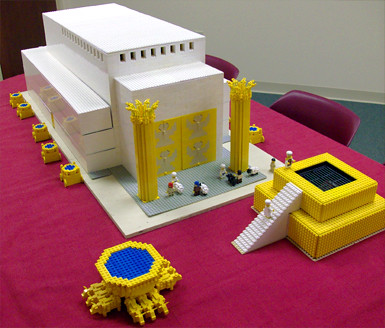
Solomon's Temple
I've previously noted Thomas's (Tbone tbl's) Solomon's Temple project. He's recently added some images of the whole thing put together.
Tuesday, June 16, 2009
Falun Gong
Falun Gong is a spiritual movement that started in China in 1992 and gained up to 100,000,000 followers in less than ten years. The Chinese government has seen these people as a threat to their power, and they have faced extensive persecution. There is even an accusation (denied by China but supported by various independent journalists and human rights organizations) that they are harvesting organs from live (unwilling) Falun Gong members. Rocko made this vig at the time of last summer's Olympics, hoping that the media attention on Beijing would highlight these human rights abuses. Sadly, NBC at least was much more interested in the spectacle of the opening ceremonies and the beautiful facilities that the PRC had constructed than they were in the dirty secrets behind the scenes.

Monday, June 15, 2009
Giant church
Last Christmas, the Addis family decorated their home with a giant church based on the All Saints Church in Earls Barton, Northamptonshire. According to the article it took them 48 days to build and it was up in their home until Twelth Night, when the bricks all got taken apart and put away until next year's Christmas display.

Sunday, June 14, 2009
Eternal punishment
Last winter Classic-Castle, a LEGO site devoted to castle builders, held their annual contest. One of the categories was "crime and punishment." Luis Baixinho was inspired by Dante's Inferno to come up with an eternal punishment in Murder gives you Hell.


Saturday, June 13, 2009
Sinners in the Hands of an Angry God
Jonathan Edwards was a Congregational minister in colonial America and a key figure in the First Great Awakening in the 1730s and 1740s. He is perhaps best known for his sermon, Sinners in the Hands of an Angry God, here illustrated by Mr. Mandolin. Edwards' sermon emphasized the reality of Hell and the fate of all unrepentant sinners in the absence of God's mercy. Coincidentally, the Internet Monk blogged on Edwards' sermon just a couple of days ago. He's got an interesting blog and podcast that I would recommend.

Friday, June 12, 2009
Great Buddha of Kamakura
The city of Kamakura, Japan, is perhaps best known for the giant statue of Amida Buddha in the courtyard of the Kōtoku-in Temple. This bronze statue, probably made in 1252, weighs approximately 93 tons. This model is found in Legoland Billund. Photo credit goes to "raisin bun".

Thursday, June 11, 2009
The almighty dollar
The relationship between money and religion has always been problematic. Dante placed simonists - those who bought and sold clerical positions - in the eighth circle of Hell. The Protestant Reformation was, in part, driven by Luther's reaction to the selling of indulgences. In recent years we've seen scandals related to money with prominent televangelists. Zelimir Peris created Father, son and holy money for a politics MOC contest.

Wednesday, June 10, 2009

Tuesday, June 9, 2009
Church of the Flying Spaghetti Monster
The Church of the Flying Spaghetti Monster is a parody created during the debates over teaching intelligent design in schools. In essence, Bobby Henderson argued that it was just as reasonable to teach that a big plate of pasta created the universe. The initial parody has grown in popularity, leading to books, t-shirts and a twist on the fish emblem you'll see some Christians put on their cars. Chris Doyle came up with his own LEGO Church of the Flying Spaghetti Monster, full of details such as the "Touched by his noodly appendage" mural seen on the side of the building.

Monday, June 8, 2009
Abston Church of Christ
The Abston Church of Christ is a huge project by Amy Hughes, built between 2000 and 2002. This is not based on a particular church, but is instead is from her imagination (the name of the fictional town of Abston comes from ABS, Acrylonitrile Butadiene Styrene, the polymer used in LEGO bricks). This is about 7 feet by 5 1/2 feet by 30 inches in size and she has populated it with figures representing her friends and other LEGO hobbyists. She even wrote a sermon to be given by the minifigure pastor at the church's dedication, that gives some of her thoughts about the importance of churches, both life-size ones and, by extension, her LEGO model. This was a real labor of love, and from the things she says in her sermon, to some extent an act of worship (see my previous post on "why build religious MOCs?). Sadly, one of the cats you see in some of the pictures died on the day she finished the model, so she dedicated it in Precious' memory.
This church has become an internet meme. You see these images re-posted all over the place and I'm regularly sent links by friends who know I am a LEGO hobbyist. If you do a Google image search on "LEGO church," 18 of the first 20 hits are of Amy's work. I have to admit a little confusion as to why this particular LEGO church gets so much more attention than others, including some of the incredible gothic cathedrals I've already posted and others I still plan on posting. No knock on Amy's work, it's just there are so many amazing creations out there. Perhaps it is because it is one of the earlier large church MOCs on the web, and so has had more time to seep into the collective consciousness. Perhaps it is because it is a modern church and so stands out from the replicas of older structures - the architecture is more clean and colorful, for instance, and so may stick out for some people. Perhaps it is because of the pictures of her cats inside the church. I'm not sure. Any thoughts?


This church has become an internet meme. You see these images re-posted all over the place and I'm regularly sent links by friends who know I am a LEGO hobbyist. If you do a Google image search on "LEGO church," 18 of the first 20 hits are of Amy's work. I have to admit a little confusion as to why this particular LEGO church gets so much more attention than others, including some of the incredible gothic cathedrals I've already posted and others I still plan on posting. No knock on Amy's work, it's just there are so many amazing creations out there. Perhaps it is because it is one of the earlier large church MOCs on the web, and so has had more time to seep into the collective consciousness. Perhaps it is because it is a modern church and so stands out from the replicas of older structures - the architecture is more clean and colorful, for instance, and so may stick out for some people. Perhaps it is because of the pictures of her cats inside the church. I'm not sure. Any thoughts?
Sunday, June 7, 2009
American archeological sites
Turning to another LEGO exhibit, this one at the Suria KLCC shopping complex at the base of the Petronis Towers in Kuala Lumpur, Malaysia, we find two sites that were significant in the religions of different American cultures. Machu Picchu is one of the most significant archaeological sites from the Incan Empire, located atop a mountain in Peru. This site was constructed in the 15th century, but was soon abandoned, perhaps because of a smallpox outbreak. The location of Machu Picchu is centered among mountain peaks that line up with astronomical events significant to the faith system of the Incans, and temples that were in this complex seem to relate to the cycles of the sun. El Castillo, the main pyramid at the Chichen Itza site in southern Mexico, was built between the 11th and 13th centuries as part of the Mayan empire. If you climb up the 365 steps (days of the year), ascending through 9 layers (number of underwolds in their mythology), you'll come to a temple to Kukulcan, their equivalent of the Aztec god Quetzalcoatl.


Saturday, June 6, 2009
Angkor Wat
Piece of Peace is a display designed by LEGO Master Builder Kazuyoshi Naoe that recreates a number of UNESCO World Heritage sites in LEGO form. This display has been traveling around Japan (and elsewhere?) for the past several years. A great number of models depict religiously significant sites, and I'm going to try to highlight each of these. Angkor Wat was built as a Hindu temple at the direction of Suryavarman II, king of the Khmer Empire (centered in what is now Cambodia), in the 12th century. The design of the temple was meant to resemble Mount Meru, essentially the Hindu equivalent of Mount Olympus. Two centuries later, a new king, Srindravarman, converted the empire over to his own religion, Buddhism, and the temple was rededicated to this purpose. Today Angkor Wat is still revered by Cambodian Buddhists and has become a symbol of Cambodia. Photo credit goes to Claudia~~~~.

Hinduism Buddhism PieceofPeace Architecture OfficialDisplay
Hinduism Buddhism PieceofPeace Architecture OfficialDisplay
Friday, June 5, 2009
Why build religious MOCs?
In the comments to a previous post on a LEGO Solomon's Temple, Dan writes:
This was a good point that got me thinking. Why do we choose to build religious subject matter? I came up with four reasons. I'd be interested to hear others' thoughts on these and suggestions as to other motives.
Didactic reasons

Sometimes a LEGO creation is built to make some point or to teach some lesson in relation to religion. I've previously blogged several of these already. For instance, Dan and Peter made their Passion of Christ films explicitly to teach others the Easter story. I've noted Steven Schwartz's presentations that teach Jewish kids about their history. A point doesn't have to be in favor of a particular faith. For example, Brendan is up front that he is trying to make a point about the ways in which he feels that the Bible is an unworthy text upon which to base your life in his illustration of the Brick Testament. Satire is another way of making a didactic point.
Inspired by art and architecture

As Dan notes above, we often draw our inspiration for MOCs* from existing art or architecture. For instance, I've already blogged Saint Peter's Basilica and the Dome of the Rock by Arthur Gugick. He's created other cathedrals, the Taj Mahal, a Mormon temple and other buildings that I'll surely blog here in the future. In addition, though, he has an Empire State Building, Big Ben, the White House, the Roman Coliseum and a huge number of other architectural landmarks. Now I have no idea of Arthur's religious views, but I do know that he is not simultaneously a Catholic, a Muslim, a Mormon, a follower of ancient Mayan religions and a worshiper of the Great Wall of China. He chooses his subject matter because he is inspired by architecture and these great cultural landmarks. I don't think anyone could walk into Notre Dame, for instance, without being impressed with it as a building and thinking it would be a great subject of a model regardless of one's views on the Christian faith. The same could be said about religious art.
I should note that I think that many of those who created the original art or architecture were doing so as an act of worship. Yes, I'm sure that there were other motivations as well--they could be making them just for the money, or for the desire of lasting fame. However, it seems to me that the creation of these was often an act of devotion. The same could be true of the LEGO builder who is following their initial leading.
*By the way, for the non-LEGO-hobbyists who might be reading this blog, MOC stands for My Own Creation--something built out of LEGO that is not based upon a set of instructions, but rather the builder's own creativity.
Expression of ingrained culture

For some, I believe, religious building comes out of an ingrained culture. Western literature is full of Christ-figures, for instance, in part because the authors grew up surrounded by this sort of imagery, and often believed in Christ themselves. C.S. Lewis wrote that when he began The Lion the Witch and the Wardrobe he had no initial conscious desire to write a Christian work, but that the symbolism crept in. As the story developed, he decided to make it intentionally didactic, but at first, at least, Aslan's identity was a natural growth out of Lewis' own religiosity. I think the same could be said about many LEGO builders who are also religious. There are infinite possible subjects for our building--from spaceships to castles to abstract art to cartoon characters to everyday objects. Sometimes subjects become natural to us because they are an important part of our own characters. I think the many LEGO nativity scenes, such as this by Watchman are examples of this sort of thing. The builders could make anything; or if we limited ourselves to considering Christmas decor they could make Santas or snowmen. They chose, though, to create something that is (for many at least) important to their religious beliefs. This is not quite the same thing as an act of devotion, but it is close.
Worship

Finally, there is worship, or devotion. Dan noted that he felt the previously blogged Solomon's Temple was this sort of creation. I think the Swedish Jesus statue is another (though this probably also had some didactic intent in getting kids interested). I actually think that creations with any of the other motivations could, at least at times, fall into this area. For instance, some people from prosyletizing faiths may see doing so as following the will of God, and they may see a didactic use of LEGO as an act of worship. Others may be inspired by art in general, but most inspired by the art that matches with their deepest views, and use this inspiration to turn to LEGO. Finally, I think that the line between cultural expression and worship can often be pretty fuzzy. At Christmas time I sing carols (me being both an inheritor of Western tradition and also a religious Christian). If I'm singing "Here Comes Santa Claus", that's completely cultural. If I'm singing "O Little Town of Bethlehem", though, that is both cultural and worshipful.
Anyway, those are my thoughts. I'd be interested to hear yours. Are there motivations I've missed?
I think this is the first time I've seen LEGO building used as a form of worship. Usually, we see people approach this topic from the perspectives of satire or architecture, but reading that blog I really got the idea that this kid was using this project as a sincere expression of faith.
This was a good point that got me thinking. Why do we choose to build religious subject matter? I came up with four reasons. I'd be interested to hear others' thoughts on these and suggestions as to other motives.
Didactic reasons
Sometimes a LEGO creation is built to make some point or to teach some lesson in relation to religion. I've previously blogged several of these already. For instance, Dan and Peter made their Passion of Christ films explicitly to teach others the Easter story. I've noted Steven Schwartz's presentations that teach Jewish kids about their history. A point doesn't have to be in favor of a particular faith. For example, Brendan is up front that he is trying to make a point about the ways in which he feels that the Bible is an unworthy text upon which to base your life in his illustration of the Brick Testament. Satire is another way of making a didactic point.
Inspired by art and architecture
As Dan notes above, we often draw our inspiration for MOCs* from existing art or architecture. For instance, I've already blogged Saint Peter's Basilica and the Dome of the Rock by Arthur Gugick. He's created other cathedrals, the Taj Mahal, a Mormon temple and other buildings that I'll surely blog here in the future. In addition, though, he has an Empire State Building, Big Ben, the White House, the Roman Coliseum and a huge number of other architectural landmarks. Now I have no idea of Arthur's religious views, but I do know that he is not simultaneously a Catholic, a Muslim, a Mormon, a follower of ancient Mayan religions and a worshiper of the Great Wall of China. He chooses his subject matter because he is inspired by architecture and these great cultural landmarks. I don't think anyone could walk into Notre Dame, for instance, without being impressed with it as a building and thinking it would be a great subject of a model regardless of one's views on the Christian faith. The same could be said about religious art.
I should note that I think that many of those who created the original art or architecture were doing so as an act of worship. Yes, I'm sure that there were other motivations as well--they could be making them just for the money, or for the desire of lasting fame. However, it seems to me that the creation of these was often an act of devotion. The same could be true of the LEGO builder who is following their initial leading.
*By the way, for the non-LEGO-hobbyists who might be reading this blog, MOC stands for My Own Creation--something built out of LEGO that is not based upon a set of instructions, but rather the builder's own creativity.
Expression of ingrained culture
For some, I believe, religious building comes out of an ingrained culture. Western literature is full of Christ-figures, for instance, in part because the authors grew up surrounded by this sort of imagery, and often believed in Christ themselves. C.S. Lewis wrote that when he began The Lion the Witch and the Wardrobe he had no initial conscious desire to write a Christian work, but that the symbolism crept in. As the story developed, he decided to make it intentionally didactic, but at first, at least, Aslan's identity was a natural growth out of Lewis' own religiosity. I think the same could be said about many LEGO builders who are also religious. There are infinite possible subjects for our building--from spaceships to castles to abstract art to cartoon characters to everyday objects. Sometimes subjects become natural to us because they are an important part of our own characters. I think the many LEGO nativity scenes, such as this by Watchman are examples of this sort of thing. The builders could make anything; or if we limited ourselves to considering Christmas decor they could make Santas or snowmen. They chose, though, to create something that is (for many at least) important to their religious beliefs. This is not quite the same thing as an act of devotion, but it is close.
Worship
Finally, there is worship, or devotion. Dan noted that he felt the previously blogged Solomon's Temple was this sort of creation. I think the Swedish Jesus statue is another (though this probably also had some didactic intent in getting kids interested). I actually think that creations with any of the other motivations could, at least at times, fall into this area. For instance, some people from prosyletizing faiths may see doing so as following the will of God, and they may see a didactic use of LEGO as an act of worship. Others may be inspired by art in general, but most inspired by the art that matches with their deepest views, and use this inspiration to turn to LEGO. Finally, I think that the line between cultural expression and worship can often be pretty fuzzy. At Christmas time I sing carols (me being both an inheritor of Western tradition and also a religious Christian). If I'm singing "Here Comes Santa Claus", that's completely cultural. If I'm singing "O Little Town of Bethlehem", though, that is both cultural and worshipful.
Anyway, those are my thoughts. I'd be interested to hear yours. Are there motivations I've missed?
Thursday, June 4, 2009
Beastie Bricks
Brendan Powell Smith has announced the next five chapters of Revelation in his ongoing Brick Testament project. My comments on Brendan's interpretation of the text would probably be pretty much the same as those for his previous installment, so I'll largely keep myself to the LEGO aspects. I do think that one of Brendan's overall themes in the Brick Testament is summed up when he has one of his characters say:
Rather than give my own response, I'd be interested in hearing what others have to say to this in the comment section. Okay, on to the LEGO:

In God Tortures Everyone Except 144,000 Jews a plague of locusts comes upon the earth. I really like the star figure using a Clickit element - it kind of makes me think of a couple of places in C.S. Lewis' Voyage of the Dawn Treader where the main characters meet stars who have come to earth. The locusts themselves are great - though I might have used 1x4 hinge plates rather than 1x4 tiles to give them more articulation. Of course then you'd either have exposed studs or have to use 1x2 tiles to cover them, resulting in fatter legs. Random observation, but the illustration of 9:6 reminds me of an episode of the Family Guy, when Death was laid up with a sprained ankle and so Peter found he couldn't die, no matter what. One possible humorous way to illustrate the "seek death but will not find it" would have been to do a game of hide-and-seek, with a figure in a black robe and hood with a scythe doing the hiding. The "wish for death" scene is really effective in capturing the movement of the falling fig and the panes of glass.

God Kills One Third of Remaining Humans describes the release of four angels to bring plagues upon mankind. Interesting use of some Bionicle piece as a lion head on the army of horsemen. The black skeleton is very effective in the picture shown above. The illustration of 9:20 brings together a great collection of random LEGO elements to make the different idols. That same picture very successfully achieves the illusion of kneeling - tough with figures without knees.

Satan Thrown to Earth brings us the dragon and the pregnant woman. I've heard many different interpretations of these symbols, but Brendan chooses to play it straight, which was probably wise. The achievement of the seven heads on the dragon is well-done. The crown of stars and the destroyed microscale town are also very nice, and I really enjoyed the "war in Heaven." I probably would have used swords, but the machine guns and cannon give a touch of humor. There were a few build details in this chapter that I did not like. The white wall in 12:8-9 seems wrong - maybe it would be better to have the edge of a cloud that Satan is being thrown off of. When the woman is given eagle's wings, the wedge plates used here make her look more like Buzz Lightyear - I think the hippogriff wings would have worked better. Also, the blue flex tubing in the last image is odd. I assume these are streams of water flowing into the crack in the earth, but I don't know if this succeeds for me.

Alternative to God Proves Very Popular introduces the beast. Again, probably wise to go with a straight beast rather than to try to force some interpretation. The beast itself is well-designed, and translates very well to stone in the subsequent chapter. When the beast is giving a speech in 3:5 there's a great building backdrop behind him. The bank of microphones is also very effective. By the way, is that George Bush in the parade with the beast?

Remaining Humans Doomed to Torture shows some of the reign of the beast. The troll climbing out of the ground works very well, as does the stone beast. The illustration of 13:16 does a good job of portraying a variety of people, using different legs, the constructed skirt and legs on one fig, and the extended torso to make the really tall guy. Nice brick wall and hand stamp in that scene as well.
What's the point of repenting to a god who tortures women and children and commits mass murder?
Rather than give my own response, I'd be interested in hearing what others have to say to this in the comment section. Okay, on to the LEGO:
In God Tortures Everyone Except 144,000 Jews a plague of locusts comes upon the earth. I really like the star figure using a Clickit element - it kind of makes me think of a couple of places in C.S. Lewis' Voyage of the Dawn Treader where the main characters meet stars who have come to earth. The locusts themselves are great - though I might have used 1x4 hinge plates rather than 1x4 tiles to give them more articulation. Of course then you'd either have exposed studs or have to use 1x2 tiles to cover them, resulting in fatter legs. Random observation, but the illustration of 9:6 reminds me of an episode of the Family Guy, when Death was laid up with a sprained ankle and so Peter found he couldn't die, no matter what. One possible humorous way to illustrate the "seek death but will not find it" would have been to do a game of hide-and-seek, with a figure in a black robe and hood with a scythe doing the hiding. The "wish for death" scene is really effective in capturing the movement of the falling fig and the panes of glass.
God Kills One Third of Remaining Humans describes the release of four angels to bring plagues upon mankind. Interesting use of some Bionicle piece as a lion head on the army of horsemen. The black skeleton is very effective in the picture shown above. The illustration of 9:20 brings together a great collection of random LEGO elements to make the different idols. That same picture very successfully achieves the illusion of kneeling - tough with figures without knees.
Satan Thrown to Earth brings us the dragon and the pregnant woman. I've heard many different interpretations of these symbols, but Brendan chooses to play it straight, which was probably wise. The achievement of the seven heads on the dragon is well-done. The crown of stars and the destroyed microscale town are also very nice, and I really enjoyed the "war in Heaven." I probably would have used swords, but the machine guns and cannon give a touch of humor. There were a few build details in this chapter that I did not like. The white wall in 12:8-9 seems wrong - maybe it would be better to have the edge of a cloud that Satan is being thrown off of. When the woman is given eagle's wings, the wedge plates used here make her look more like Buzz Lightyear - I think the hippogriff wings would have worked better. Also, the blue flex tubing in the last image is odd. I assume these are streams of water flowing into the crack in the earth, but I don't know if this succeeds for me.
Alternative to God Proves Very Popular introduces the beast. Again, probably wise to go with a straight beast rather than to try to force some interpretation. The beast itself is well-designed, and translates very well to stone in the subsequent chapter. When the beast is giving a speech in 3:5 there's a great building backdrop behind him. The bank of microphones is also very effective. By the way, is that George Bush in the parade with the beast?
Remaining Humans Doomed to Torture shows some of the reign of the beast. The troll climbing out of the ground works very well, as does the stone beast. The illustration of 13:16 does a good job of portraying a variety of people, using different legs, the constructed skirt and legs on one fig, and the extended torso to make the really tall guy. Nice brick wall and hand stamp in that scene as well.
Subscribe to:
Posts (Atom)