
Wednesday, November 17, 2010
Christuskirche
Built between 1907 and 1910, the Christuskirche, or Christ Church, is a Lutheran congregation in Windhoek, Namibia. Lutheranism is the largest religious grouping in Namibia (50% of the population), going back to its years as a German imperial protectorate. This LEGO rendition was donated by a local toy store as part of the 100 year celebration of the Christuskirche.

Tuesday, November 16, 2010
Sacré Cœur
Built between 1875 and 1914, the Basilique du Sacré Cœur looks out over the city of Paris. A LEGO rendition of this Catholic bassilica looks out over a Paris Toys R Us store.

Sunday, November 14, 2010
Yivli Minare Mosque
The Yivli Minare Mosque is one of the oldest Islamic buildings in Antalya, Turkey. Around 1225 a Byzantine church was transformed into a mosque. This building was destroyed the next century, and rebuilt in 1373. Today this building no longer functions as a mosque, but is rather a museum.

This microscale creation was part of a huge collaborative display by European LEGO builders. Conceived by Tobias Reichling and Bruno Kurth, five builders constructed a huge (fifteen square meters) LEGO map of Europe and twenty different people contributed forty-four microscale versions of famous European landmarks.

This microscale creation was part of a huge collaborative display by European LEGO builders. Conceived by Tobias Reichling and Bruno Kurth, five builders constructed a huge (fifteen square meters) LEGO map of Europe and twenty different people contributed forty-four microscale versions of famous European landmarks.
Thursday, November 11, 2010
Hail, Mary
A Marian procession is an old tradition that is not practiced today as much as in the past. Mister Zumbi made a LEGO version. Who knew that Batman was Catholic? :)

Friday, November 5, 2010
Stained glass
Survivors of Trauma at Saint Silas Church in Belfast is a support center for victims of the sectarian violence there in recent years. Alyska of PottyKittyStudios made a great version of the stained glass window at Saint Silas. This was recently on display at LEGO KidsFest.

Thursday, November 4, 2010
Silver Chair
The Chronicles of Narnia by C.S. Lewis are full of Christian symbolism. One of the main themes of the Silver Chair is learning to follow God's leading, even when you are in unfamiliar circumstances. Andrew Becraft illustrates the giant steps encountered by the main characters.

Wednesday, November 3, 2010
Día de los Muertos
Yesterday was Día de los Muertos, or Day of the Dead. This holiday, celebrated in Mexico and by some Mexican Americans, is derived from the Catholic feasts of All Saints (November 1) and All Souls (November 2), remembering those who died. Celebrants often visit the graves of their family members and bring along food and other remembrances. Pasukaru76 has a humorous take on this, taking out great-great-great-great-grandpa for a coffee.

Tuesday, November 2, 2010
Read with meaning
Mezba Mahtab has started a new project Teaching Kids the Holy Quran. He's using LEGO to illustrate passages from the Quran. He's planning on a couple of updates a month, so we'll be sure to check back regularly.


Monday, November 1, 2010
Diet of Worms
True story - in my high school European history class, our teacher had one of the students convinced that the diet of worms was a special weight-loss plan for Emperor Charles V. Unfortunately for that student, this was really the assembly where Martin Luther refused to step down from his teachings. Chris Wunz illustrated this in recognition of Reformation Sunday.

Sunday, October 31, 2010
Reformation Sunday
On this day in 1517, Martin Luther nailed his 95 theses to the door of All Saints' Church in Wittenberg. Jojo tells the story of Luther's life in LEGO form.

I've previously noted Jojo's work on this and included more explanation. Happy Reformation Sunday.
I've previously noted Jojo's work on this and included more explanation. Happy Reformation Sunday.
Saturday, October 30, 2010
The Assemblies of God want you ... to build LEGO
I was contacted by Gina Copeland of the Assemblies of God. They are looking to hire someone to create a large interactive LEGO display at a convention in Phoenix, Arizona, next August. If you are interested, please contact her at gcopeland@ampforlife.com for more details.
Friday, October 29, 2010
Arctic Cathedral
The Tromsdalen Kirke is more commonly known as the Arctic Cathedral. Built in 1965 in the extreme north, Tromsø, Norway, this church celebrates the interplay of light, with one end taken up by a huge triangular window surrounding a cross and the other end forming Europe's largest stained glass window. The eleven spires represent the apostles who remained with Jesus after Judas' betrayal. Tobias Reichling built a microscale version of this church.

This microscale creation was part of a huge collaborative display by European LEGO builders. Conceived by Tobias Reichling and Bruno Kurth, five builders constructed a huge (fifteen square meters) LEGO map of Europe and twenty different people contributed forty-four microscale versions of famous European landmarks.
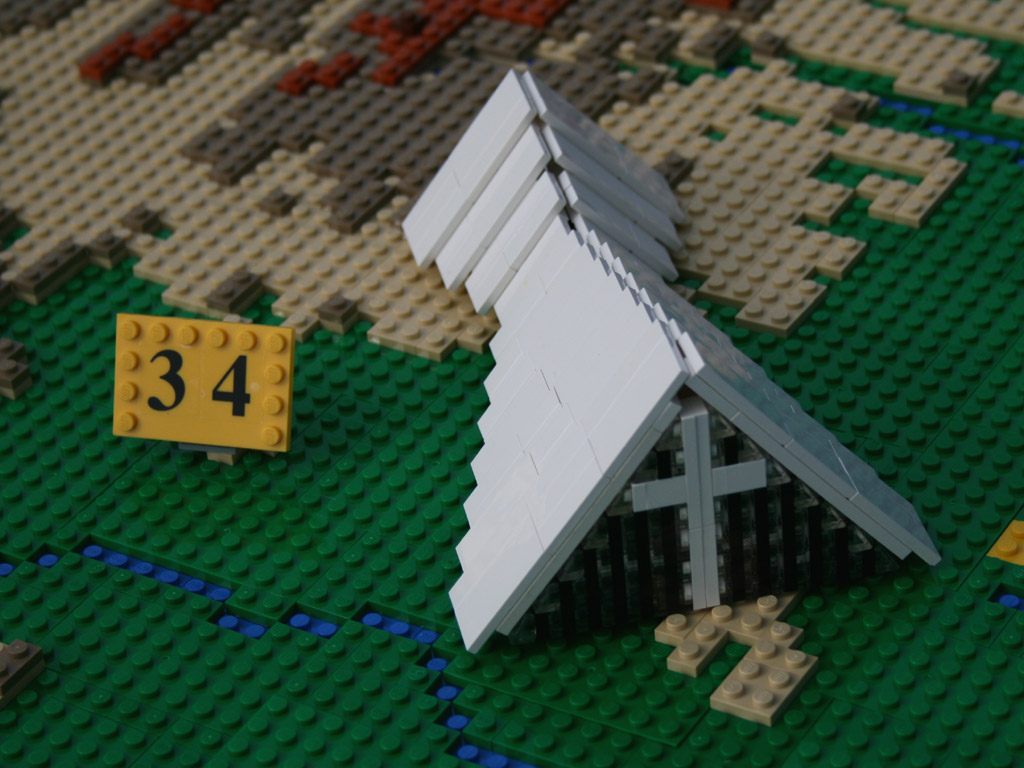
This microscale creation was part of a huge collaborative display by European LEGO builders. Conceived by Tobias Reichling and Bruno Kurth, five builders constructed a huge (fifteen square meters) LEGO map of Europe and twenty different people contributed forty-four microscale versions of famous European landmarks.
Wednesday, October 27, 2010
Greeted by angels
Angyalok visznek Őhozzá was built by Orangyal007 in memory of a friend who recently passed away. This translates, roughly, into "angels take you" and shows her being greeted in Heaven by Saint Peter and Jesus.

Tuesday, October 26, 2010
Genesis
I've been very remiss in covering recent additions to The Brick Testament. Brendan has been systematically going back and rebuilding or adding to stories from Genesis. Personally, I'd like to see him take on some of the material he hasn't already covered, particularly some of the less-narrative sections like the Psalms or the Prophets.

Abram Impregnates a Slave Girl tells the story of Sarai, Hagar and Ishmael. From a LEGO standpoint, I really like the scene above with the clever hammock design, the skateboard ramps forming the tent, the variety of molded and brick-built animals, and the implied action in the distance and around the edges. When the same scene is mirrored three scenes later, the look on Sarai's face is perfect. I've never been a huge fan of the 1x2 tile-as-pregnant-belly solution, but I don't know a better way to imply a pregnant minifig.

God Wants Part of Penis Cut Off tells about the initiation of circumcision. Some humorous scenes here with the looks on the faces of those being circumcised, and also lying down in the background. I'm not a fan of the dagger. I know, I know, it's an official piece from the Prince of Persia line, but it just doesn't look like LEGO to me.

God Drops By for a Meal tells of three strangers who pay a visit to Abram. Those palm trees in the distance are very simple and yet effective when in soft focus. The larger tree close to Abram's tent doesn't work as well when it is in sharp focus here as opposed to the soft focus seen in some of the earlier stories. I'm not sure if I like the molded dog modified to be a calf - I think that Brendan had a better brick-built calf design in the past. Kind of odd but humorous that God isn't facing Abram as he's talking to him while he eats.
Abram Impregnates a Slave Girl tells the story of Sarai, Hagar and Ishmael. From a LEGO standpoint, I really like the scene above with the clever hammock design, the skateboard ramps forming the tent, the variety of molded and brick-built animals, and the implied action in the distance and around the edges. When the same scene is mirrored three scenes later, the look on Sarai's face is perfect. I've never been a huge fan of the 1x2 tile-as-pregnant-belly solution, but I don't know a better way to imply a pregnant minifig.
God Wants Part of Penis Cut Off tells about the initiation of circumcision. Some humorous scenes here with the looks on the faces of those being circumcised, and also lying down in the background. I'm not a fan of the dagger. I know, I know, it's an official piece from the Prince of Persia line, but it just doesn't look like LEGO to me.
God Drops By for a Meal tells of three strangers who pay a visit to Abram. Those palm trees in the distance are very simple and yet effective when in soft focus. The larger tree close to Abram's tent doesn't work as well when it is in sharp focus here as opposed to the soft focus seen in some of the earlier stories. I'm not sure if I like the molded dog modified to be a calf - I think that Brendan had a better brick-built calf design in the past. Kind of odd but humorous that God isn't facing Abram as he's talking to him while he eats.
Monday, October 25, 2010
Stonehenge
There is no clear picture of the original use of Stonehenge. It certainly wasn't built by the Druids, as it pre-dated them. Constructed in phases spanning more than a millenium between 3000 and 1600 BC in the plains of England by people who left no written records, there is a great deal of debate about why they built it. There are a large number of burial sites in the region, and one theory holds that this was a place for religious rites concerning the dead, possibly a form of ancestor worship. The stones themselves line up with the sun and stars on particular days such as the solstices, and some claim this was more of an early astronomical observatory. Often these ancient cultures placed great significance on these days and/or worshiped the sun, moon and stars as deities, so this alignment may have been used to mark religious festivals. Tobias Reichling made a microscale version of the famous stone circle.

This microscale creation was part of a huge collaborative display by European LEGO builders. Conceived by Tobias Reichling and Bruno Kurth, five builders constructed a huge (fifteen square meters) LEGO map of Europe and twenty different people contributed forty-four microscale versions of famous European landmarks.

This microscale creation was part of a huge collaborative display by European LEGO builders. Conceived by Tobias Reichling and Bruno Kurth, five builders constructed a huge (fifteen square meters) LEGO map of Europe and twenty different people contributed forty-four microscale versions of famous European landmarks.
Saturday, October 23, 2010
Sint Maarten
Sint Maarten, or Martin of Tours, lived in the Roman Empire during the fourth century, where he served in the cavalry as a young man. In a famous incident, he cut his cloak in half to share with a beggar. Even though he became a pacifist after his conversion and left the military, in later centuries the Frankish kings kept his cloak as a relic that they would bring with them into battle. The priest who carried this relic was called a 'cappellanu', which is the precursor to the word 'chaplain'. Bart Willen illustrated the story of Saint Martin in LEGO form.

Thursday, October 21, 2010
Hallgrímskirkja
The sixth tallest structure and the largest place of worship in Iceland is the Lutheran church Hallgrímskirkja. Built between 1945 and 1986, it is named for Hallgrímur Pétursson, a poet and pastor known for writing the Passion Hymns. The distinctive sweeping curves of the front tower are meant to reflect shapes found in the volcanic landscape surrounding Reykjavík. Bruno Kurth built this microscale version.

This microscale creation was part of a huge collaborative display by European LEGO builders. Conceived by Tobias Reichling and Bruno Kurth, five builders constructed a huge (fifteen square meters) LEGO map of Europe and twenty different people contributed forty-four microscale versions of famous European landmarks.

This microscale creation was part of a huge collaborative display by European LEGO builders. Conceived by Tobias Reichling and Bruno Kurth, five builders constructed a huge (fifteen square meters) LEGO map of Europe and twenty different people contributed forty-four microscale versions of famous European landmarks.
Tuesday, October 19, 2010
Borgund Stave Church
Stave churches were once common in northern Europe, particularly in Norway. These wooden churches were characterized by walls made of vertical boards and they tended to have steep roofs, often rising in multiple layers. One of the most famous remaining stave churches stands in Borgund, Norway. It was built around 1180 and dedicated to the Apostle Andrew. Ina Nilsson built this microscale version.

This microscale creation was part of a huge collaborative display by European LEGO builders. Conceived by Tobias Reichling and Bruno Kurth, five builders constructed a huge (fifteen square meters) LEGO map of Europe and twenty different people contributed forty-four microscale versions of famous European landmarks.
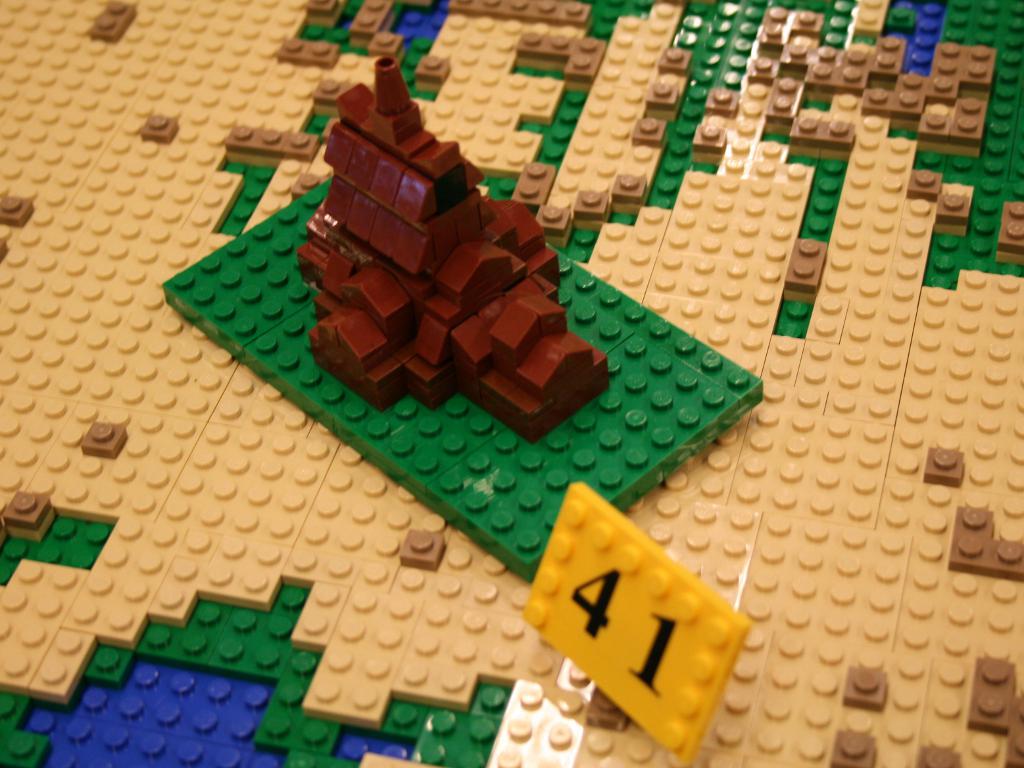
This microscale creation was part of a huge collaborative display by European LEGO builders. Conceived by Tobias Reichling and Bruno Kurth, five builders constructed a huge (fifteen square meters) LEGO map of Europe and twenty different people contributed forty-four microscale versions of famous European landmarks.
Sunday, October 17, 2010
Abu Simbel
The Great Temple at Abu Simbel in southern Egypt was built by Ramesses II in the 13th century BC. It was dedicated to Amun Ra, Ra-Horakhty and Ptah, the three most important gods of the time, and also to Ramesses himself, celebrated as a god. The nearby Small Temple is dedicated to the goddess Hathor and Ramesses' queen Nefertari. The Great Temple was constructed in such a way that on two days, thought to be the dates of Ramesses birth and coronation, sunlight would shine through the entrance to the innermost chamber, where it would illuminate the statues of Amun Ra, Ra-Horakhty and Ramesses. The statue of Ptah always stayed in darkness as he was god of the underworld. Jumping forward three thousand years, the temples were completely excavated and moved during the 1960s to protect them from inundation as the waters of Lake Nasser rose behind the Aswan Dam.

Jonathan Gilbert built this microscale version of the Great Temple as an entry in the ancients category of the Mini Castle Contest over on Classic-Castle.
Jonathan Gilbert built this microscale version of the Great Temple as an entry in the ancients category of the Mini Castle Contest over on Classic-Castle.
Friday, October 15, 2010

Subscribe to:
Posts (Atom)