Showing posts with label other faiths. Show all posts
Showing posts with label other faiths. Show all posts
Sunday, September 27, 2015
Mid-Autumn Festival
Today is the Mid-Autumn Festival in China and Vietnam, another of those traditions with roots in religious meanings that is today more of a cultural holiday. This day celebrates the harvest, and focuses on gathering with family and friends, giving thanks, and prayers for future blessings. In its ancient origins, this festival focused on worshiping the mountain gods, a dragon, or the moon god for the crops, and also for the birth of children. Today it is more a day for fun, food, dragon dances, moon cakes, and time with family and friends. Jared Chan made this rabbit--the rabbit is associated with this festival based on the tradition of the moon rabbit, a companion of the moon goddess Chang'e.

Thursday, August 27, 2015
Ondel-Ondel
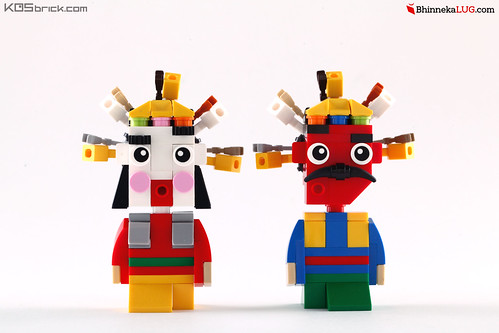
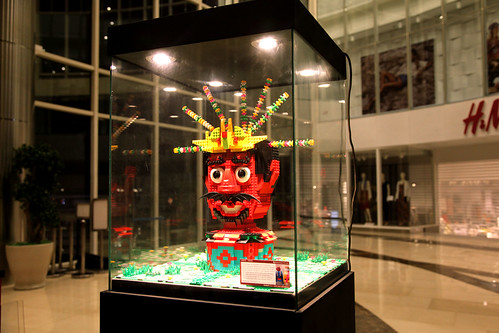
One of the prominent folk arts of the Betawi people of Indonesia are the Ondel-Ondel puppets/costumes. These large colorful figures are donned by dancers at various festivals and cultural events. While today it is more of a cultural practice, these figures come from folk beliefs, where they seem to have originally represented the ancestors who watch over the people and protect them from evil spirits. Here are Ondel-Ondel figures and mask by Kosmas Santosa and Dendi Pratama.
Sunday, May 11, 2014
Sacred grove
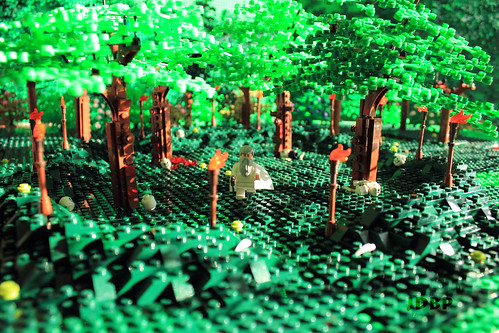
James Pegrum made this Druid's sacred grove. Here's his description:
200cBC, Medionemeton (now in Southern Scotland). A Druid leaves the Sacred Grove and heads back to his local tribe.
During the Iron Age the Druids were a priestly class within Celtic society, both in and beyond Britain. These priests played an important part in Celtic society. It took 20 years of training to become a Druid (according to Caesar). The Greeks and Romans writers also refer to the druids making human sacrifices, a matter which lead the Romans to pursue the druids and try to stop their religion.
The Druids carried out their rituals in Sacred Groves (Nemetons), which were small groups of trees were surrounded by a ditch and possible with a palisade around the enclosure (I've shown it with burning torches!).
The druids did not write and so their is little written records about these mystical priests. The main records come from the Greeks and Romans.
200cBC, Medionemeton (now in Southern Scotland). A Druid leaves the Sacred Grove and heads back to his local tribe.
During the Iron Age the Druids were a priestly class within Celtic society, both in and beyond Britain. These priests played an important part in Celtic society. It took 20 years of training to become a Druid (according to Caesar). The Greeks and Romans writers also refer to the druids making human sacrifices, a matter which lead the Romans to pursue the druids and try to stop their religion.
The Druids carried out their rituals in Sacred Groves (Nemetons), which were small groups of trees were surrounded by a ditch and possible with a palisade around the enclosure (I've shown it with burning torches!).
The druids did not write and so their is little written records about these mystical priests. The main records come from the Greeks and Romans.
Friday, May 2, 2014
Official Anubis
Anubis has found his way into multiple official LEGO sets as well, the only religious character to do so (albeit from a dead religion). As the jackal-headed god is highly recognizable, he shows up in sets every time LEGO ventures into Egypt. The Oasis Ambush and Sphinx Secret Surprise sets both include Anubis statues.


Set 5988 is the Temple of Anubis, and he is both in a statue and in the heiroglyphics.

Indiana Jones and the Lost Tomb features two Anubis statues, and also the Ark of the Covenant.

LEGO came back to Egypt a couple of years ago with the Pharoah's Quest sets, and again Anubis was there. As a sphinx in Rise of the Sphinx and then as an Anubis guard minifig in the Scorpion Pyramid set.


Set 5988 is the Temple of Anubis, and he is both in a statue and in the heiroglyphics.
Indiana Jones and the Lost Tomb features two Anubis statues, and also the Ark of the Covenant.
LEGO came back to Egypt a couple of years ago with the Pharoah's Quest sets, and again Anubis was there. As a sphinx in Rise of the Sphinx and then as an Anubis guard minifig in the Scorpion Pyramid set.
Tuesday, April 29, 2014
Anubis
Here are some more LEGO renditions of Anubis:
Pascal built this temple.
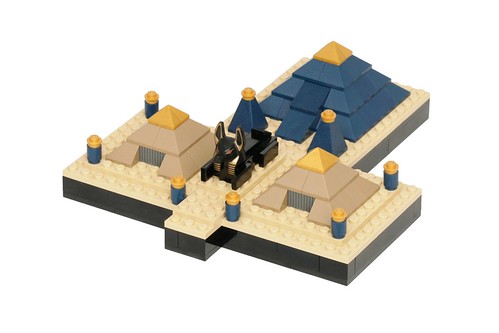
Sir Nadroj built these statues.
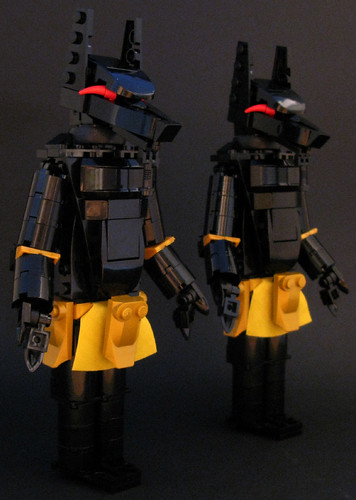
David Alexander Smith made Anubis and Ra.

This version was in the "LEGO: Secrets of the Pharoahs display at Science World Vancouver.
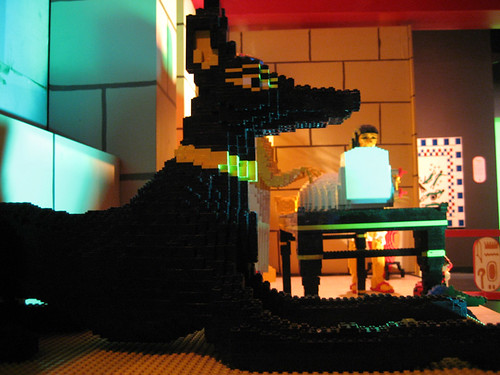
Pascal built this temple.
Sir Nadroj built these statues.
David Alexander Smith made Anubis and Ra.
This version was in the "LEGO: Secrets of the Pharoahs display at Science World Vancouver.
Saturday, April 26, 2014
Anubis
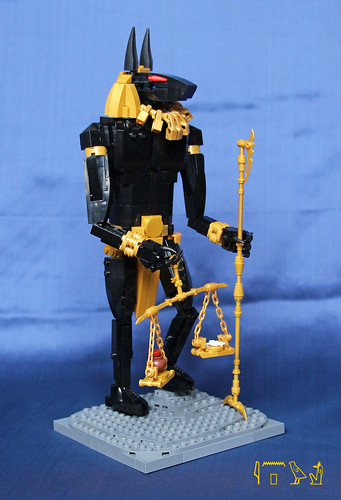
One of the roles of Anubis in ancient Egyptian belief was the weighing of the heart. After death, Anubis would compare the deceased's heart to an ostrich feather representing truth. If the heart was heavier (therefore impure), the demon Ammit would devour the soul. Otherwise the soul would go on to immortality with Osiris. Inquisitor88 depicts Anubis and his scales.
Friday, April 25, 2014
Monday, August 19, 2013
Taiwanese Temple
I'm not sure if BLACKWHITE's Taiwan street temple is based on a specific temple or not. It certainly reflects the structural style of a lot of buildings like the Longshan Temple or the Confucious Temple, but it doesn't exactly match any that I can find. It might just be a combination of details from many different sites. Of course, since the builder is (I'm pretty sure) from Taipei, this doesn't have to be a particularly famous structure, it could just be a small temple down the street that he goes past every day. Can someone translate the text in the first picture for me?


Wednesday, August 14, 2013
You put the lime in the coke, you nut
In ancient times, the chewing of coca leaves was part of certain religious ceremonies in different cultures in the Andes of South America. The stimulant properties of the leaves are enhanced by adding a little bit of quicklime, as this helps neutralize stomach acid and increase the absorption of the alkaloids into the bloodstream. This lime was kept in ceremonial vessels known as poporos. Pablo Ramirez built this rendition of the Poporo Quimbaya, a gold artifact of the Quimbaya civilization dated to about 1700 years ago. This container has become somewhat of a symbol of pre-Columbian culture in Columbia, and appears on some of their currency.

*While the practice of chewing coca leaves was restricted to upper classes in certain ceremonial uses in earlier times, in recent centuries it has become very common in some Andean regions. This has become a source of contention, as the US and international organizations wanting to stop the production of cocaine have come up against poor farmers who defend the production and chewing of the leaves (with a small amount of lime) as an indigenous practice. I've read conflicting reports from people on both sides of this, with some referring to the practice as essentially a low grade cocaine addiction, and others saying it is a folk remedy for altitude sickness and less of a kick than a cup of coffee.
**BTW, despite my title, the mineral lime used in the chewing of coca leaves has no relation to the citrus fruit lime. The word for the mineral comes from the Old English lim, which refers to a sticky substance, as lime was used in making mortar. The word for the fruit comes from the Arabic limah, referring to a citrus fruit. It's ironic that these two different meanings ended up with the same word in modern English, since the mineral is basic and the fruit is acidic. On the other hand, coca leaves are used in the production of Coca Cola, though ever since 1904 the leaves have first been processed to remove any cocaine.
*While the practice of chewing coca leaves was restricted to upper classes in certain ceremonial uses in earlier times, in recent centuries it has become very common in some Andean regions. This has become a source of contention, as the US and international organizations wanting to stop the production of cocaine have come up against poor farmers who defend the production and chewing of the leaves (with a small amount of lime) as an indigenous practice. I've read conflicting reports from people on both sides of this, with some referring to the practice as essentially a low grade cocaine addiction, and others saying it is a folk remedy for altitude sickness and less of a kick than a cup of coffee.
**BTW, despite my title, the mineral lime used in the chewing of coca leaves has no relation to the citrus fruit lime. The word for the mineral comes from the Old English lim, which refers to a sticky substance, as lime was used in making mortar. The word for the fruit comes from the Arabic limah, referring to a citrus fruit. It's ironic that these two different meanings ended up with the same word in modern English, since the mineral is basic and the fruit is acidic. On the other hand, coca leaves are used in the production of Coca Cola, though ever since 1904 the leaves have first been processed to remove any cocaine.
Tuesday, August 13, 2013
Pura Tanah Lot
Tanah Lot means 'Land in the Sea' - this rocky outcrop on the coast of Bali is cut off from the main land at high tide, and accessible by foot at low tide. During the 15th century, the traveling Hindu priest Nirartha rested at this spot, and was inspired by the beautiful location to found a shrine to worship the local sea gods. This recreation of Pura Tanah Lot is found in Legoland Malaysia.

Monday, August 12, 2013
Deir el Bahari
I've previously described, Deir el Bahari, a temple dedicated to the Pharoah Hatshepsut, honored as a god after her death. FifthPixel built this great rendition of this Egyptian site, illustrated here as if it were an official Architecture set.

Saturday, July 27, 2013
Machu Picchu
The Incan city of Machu Picchu (here from the Piece of Peace exhibit) isn't completely understood, but many feel that it was a sacred place, that the buildings were used to trace astronomical events in relation to religious rituals.

Thursday, July 18, 2013
Lantern Festival
This is a LEGO take on the Taiwan tourism agency's logo for the Lantern Festival. This is a Chinese festival during February (on the first full moon of the lunar year, to be precise) that is now more cultural, but may have religious origins. This celebration, which has gone on for over a thousand years, involves colorful lanterns, including sky lanterns, traditional foods, and also fireworks. There are various legends about the origin of the festival, and some of them involve folk religion. In one legend, the festival started out as a sacrifice to Taiyi, the God of Heaven. Another story says that the festival was to entertain the Taoist god Tianguan and pray for good fortune in the new year. Still another had the festival start when villagers lit red lanterns and set off fireworks to trick the Jade Emperor in heaven into believing that the village was in flames, so that he would not destroy them for killing his sacred crane. Other non-religious origin stories involve commemorating a heroic warrior and a girl who was reunited with her parents when they came to watch the flying lanterns (hmm, Tangled anyone?).

Monday, July 8, 2013
Temple of Heaven
The Temple of Heaven (here from the Piece of Peace exhibit) in Beijing dates back to 1406 (with renovation in the 18th century). Emperors of the Ming and Qing dynasties would give annual sacrifices there for good crops.

Saturday, July 6, 2013

Thursday, June 13, 2013
Philae
In Egyptian mythology, Osiris was the son of Geb, the brother and husband of Isis, and the father of Horus. After he was killed by his brother Set, Isis buried him on the island of Philae in the upper Nile. He then became king of the underworld. The island became the location of a whole complex of temples, built over a period of about 500 years, and a center for devotion to Isis and Osiris, among other deities. One of the largest structures is Trajan's Kiosk, built perhaps as a resting place for Isis' boat. In the 1960's the construction of the Aswan High Dam threatened to flood the island, so all of the ruins were carefully moved to a site on higher ground at Agilkia Island.

Tuesday, April 16, 2013
Mo'ai
The Mo'ai of Easter Island (here by TheBricks) may have had religious significance to the carvers as deified ancestors. Or not. There is a lot of speculation on the actual purpose of these giant statues.

Sunday, February 10, 2013
Abu Simbel
The Great Temple at Abu Simbel (here by customBRICKS) was completed around 1265 BC and was dedicated to the gods Amun, Ra-Horakhty, and Ptah, and also to the Pharoah Ramses the Great, shown here as a god. The temple was moved in 1964 when the original site was scheduled to be submerged by the Aswan High Dam. The tumbled-down statue, though, dates to ancient times - when they moved the temple they decided to leave it as it was rather than reconstructing it.

Tuesday, January 22, 2013
Easter Island
I've written before about the Moai of Rapa Nui (Easter Island) and their potential religious significance to the original carvers. Kristi McWii made this beautiful micro version.

Monday, January 14, 2013
Thuggee cult
Following down the trail of Indiana Jones and the Temple of Doom a bit more, the main antagonist, Mola Ram, and his henchmen are portrayed as adherents to the Thuggee cult. The Thuggees, or thugs for short (that's the origin of that term), were a brotherhood of thieves and assassins in India from the 14th to the 19th century. At least some of them had a religious conviction in addition to their motivation to kill and steal (or perhaps it is possible that they used a religious story to cover over their baser motivations). They believed they were the offspring of Kali, created out of the sweat of her battle with the demon Raktavija. In their view, their victims were human sacrifices to Kali. This is complicated by the fact that very few Hindus, indeed very few devotees of Kali, were Thuggees, and also that not all Thuggees were even Hindu (some were Muslim). There also appears to be some claim that the whole association of Thuggee crime with Hinduism in any form was more of an invention of the colonial British than rooted in fact.
Here's a great depiction of the Temple of Doom by Nick Nitro Brick. There's Kali again in the backdrop. I should also note that the Thuggees of the movie were a highly fictionalized version of the real assassins. The Temple of Doom was banned in India for a time as being an offensive depiction of India and Hinduism.

Here's a great depiction of the Temple of Doom by Nick Nitro Brick. There's Kali again in the backdrop. I should also note that the Thuggees of the movie were a highly fictionalized version of the real assassins. The Temple of Doom was banned in India for a time as being an offensive depiction of India and Hinduism.
Subscribe to:
Posts (Atom)