Showing posts with label Taoism. Show all posts
Showing posts with label Taoism. Show all posts
Wednesday, December 10, 2014
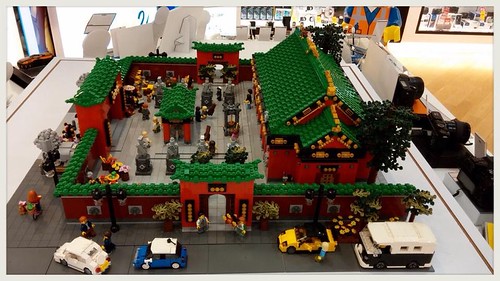
Che Kung Temple
Andy Bear built this rendition of the Che Kung Temple found in the Sha Tin district in Hong Kong. The temple is dedicated to Che Kung, a general in the Song Dynasty in the 13th century, also known as a healer. He is now revered as a god of protection.

Monday, August 19, 2013
Taiwanese Temple
I'm not sure if BLACKWHITE's Taiwan street temple is based on a specific temple or not. It certainly reflects the structural style of a lot of buildings like the Longshan Temple or the Confucious Temple, but it doesn't exactly match any that I can find. It might just be a combination of details from many different sites. Of course, since the builder is (I'm pretty sure) from Taipei, this doesn't have to be a particularly famous structure, it could just be a small temple down the street that he goes past every day. Can someone translate the text in the first picture for me?


Thursday, July 18, 2013
Lantern Festival
This is a LEGO take on the Taiwan tourism agency's logo for the Lantern Festival. This is a Chinese festival during February (on the first full moon of the lunar year, to be precise) that is now more cultural, but may have religious origins. This celebration, which has gone on for over a thousand years, involves colorful lanterns, including sky lanterns, traditional foods, and also fireworks. There are various legends about the origin of the festival, and some of them involve folk religion. In one legend, the festival started out as a sacrifice to Taiyi, the God of Heaven. Another story says that the festival was to entertain the Taoist god Tianguan and pray for good fortune in the new year. Still another had the festival start when villagers lit red lanterns and set off fireworks to trick the Jade Emperor in heaven into believing that the village was in flames, so that he would not destroy them for killing his sacred crane. Other non-religious origin stories involve commemorating a heroic warrior and a girl who was reunited with her parents when they came to watch the flying lanterns (hmm, Tangled anyone?).

Monday, July 8, 2013
Temple of Heaven
The Temple of Heaven (here from the Piece of Peace exhibit) in Beijing dates back to 1406 (with renovation in the 18th century). Emperors of the Ming and Qing dynasties would give annual sacrifices there for good crops.

Monday, February 18, 2013
Chinese New Year
I know, this is a week late. I've been busy, and also this past week has been pretty full of things to note here, with the news about the Pope and then a series of holidays with more or less connection to religious themes. A week ago yesterday was Chinese New Year, and first I need to note that this is not a religious holiday. Instead it is a cultural holiday, but Buddhist, Taoist and folk religious traditions have been tied in to this day over the years. For instance, household altars are cleaned and redecorated for the new year. Taoists will burn an effigy of the kitchen god so that he can go to the Jade Emperor to report on the family in the previous year. Buddhists will refrain from eating meat on certain days around this celebration. The Chinese zodiac is a fold tradition, but also gets tied to religious stories, for instance with Buddha picking the twelve animals. This year is the year of the snake, and LEGO celebrated by producing a limited release an official set. This set seems to be only available in Asia.

Friday, August 10, 2012
Dongyue Temple
Mount Tai in eastern China has been a site of worship for over 3000 years. There are a number of Taoist and Confucian temples, and in ages past the emperor of China came to this site to make sacrifices to heaven and earth. Dongyue dadi is revered as the god of Mount Tai, and has a number of temples around China, including this one (by Lisqr) on the mountain itself.

Saturday, May 12, 2012
Yin and Yang
The concept of yin and yang is important in various Asian religions and philosophies. The concept is that the world is full of various dualities, such as dark and light, or male and female. These dualities are interdependent, and in their interaction they create new things. These are all manifestations of the yin and the yang. This symbol has been recreated in many ways in LEGO form:
My all time favorite has to be this by Noddy.

To fully appreciate this MOC, you have to also look at it from above.

Lego27bricks recently did something similar.

Here's my own effort.

The yin/yang symbol provides a backdrop to martial artists by pguenthe ...

... and Collin Ballantyne.

Heath Flor celebrated Talk Like a Pirate Day a couple of years back with ninjas vs pirates.

The opposition is shown here by Madformax1.

Here's Remyth's Temple of Yin and Yang.

Jim Walshe ...

... and ANVRecife have had some fun with photography.

My all time favorite has to be this by Noddy.
To fully appreciate this MOC, you have to also look at it from above.
Lego27bricks recently did something similar.
Here's my own effort.
The yin/yang symbol provides a backdrop to martial artists by pguenthe ...
... and Collin Ballantyne.
Heath Flor celebrated Talk Like a Pirate Day a couple of years back with ninjas vs pirates.
The opposition is shown here by Madformax1.
Here's Remyth's Temple of Yin and Yang.
Jim Walshe ...
... and ANVRecife have had some fun with photography.
Friday, January 27, 2012
Yin and Yang
Often times in the west we think of the Yin and Yang symbol as a battle between good and evil, but that's not how it really works in Taoism and other aspects of Chinese religion and philosophy. The idea is more that there are opposite qualities that work together in a balanced system. These could be light and darkness, or, as in this Yin/Yang mosaic by Sharon Prue, hot and cold. This beautiful MOC won 'Best Fire' at a recent gathering of LEGO builders.

Friday, January 20, 2012
Happy New Year
Cai Shen is a god of prosperity in Chinese folk tradition, later venerated in Taoism and some forms of Buddhism. Today figures of Cai Shen (here by rack911) are often included in Chinese New Year decorations as tokens of good luck for wealth in the year to come.

Sunday, August 21, 2011
Cowherd and Weaver Girl
Sometimes I debate whether a MOC is truly about a religious subject, or would better be characterized as a cultural practice. For example, the Danish holiday Sankt Hans aften I blogged here earlier this month. The Chinese folktale Cowherd and Weaver Girl (here depicted by Tigerggyy) is one of these. As the story goes, the daughter of the Jade Emperor (one of the chief gods in Chinese traditional religion and also in Taoism) fell in love with a mortal cowherd. They were separated by the river of the Milky Way, but once a year the Jade Emperor allows them to meet on a bridge across the river. That day is called the Qixi Festival, the Chinese equivalent of Valentine's Day.

Wednesday, August 3, 2011
Long Hu
I'm not sure if I should be featuring this here or not. The Long Hu Tower, or Dragon Tiger Tower is named after Long Hu Mountain in China, a holy region seen as one of the birthplaces of Taoism. I don't know if these towers in Taiwan have any religious significance, or if they are more of a tourist destination.

Tuesday, July 27, 2010
Make a wish!
CREATION K.O. Creation presents the Taipo Lam Tsuen Wishing Trees. Two banyan trees are located outside a temple to the goddess Tin Hau in Lam Tsuen. A supplicant will write their wish on a piece of paper, burn incense, and hang the wish from the branches of one of the trees in hopes of its fulfillment.

This is another entry in the Hong Kong LEGO contest, which has really been a great source for LEGO creations with themes from Eastern faiths.
This is another entry in the Hong Kong LEGO contest, which has really been a great source for LEGO creations with themes from Eastern faiths.
Wednesday, July 21, 2010
Wong Tai Sin Temple
The Wong Tai Sin Temple in Hong Kong is a Taoist shrine dedicated to the great immortal Wong. Born in 338, Wong practiced Taoism and became revered as a great man during his life and was later considered a god. It was only around 1900, though, that his influence spread. This temple was built in 1921 and is a popular site in Hong Kong, both for penitents and tourists.

Visitor to the temple offer burning sticks of incense and prayers at the altar to Wong Tai Sin.

One of the traditions practiced at the temple is Kau Cim, a form of an oracle where petitioners ask a question of the gods and then shake a container of bamboo sticks until one falls out. Each stick is numbered, and the number points to a fortune that can be interpreted to answer the question (though often with the help of a temple priest).

Andy Hung's LEGO rendition of the Wong Tai Sin Temple is an entry in a contest featuring various Hong Kong scenes by several AFOLs. Seen via the Brothers-Brick.
Visitor to the temple offer burning sticks of incense and prayers at the altar to Wong Tai Sin.
One of the traditions practiced at the temple is Kau Cim, a form of an oracle where petitioners ask a question of the gods and then shake a container of bamboo sticks until one falls out. Each stick is numbered, and the number points to a fortune that can be interpreted to answer the question (though often with the help of a temple priest).
Andy Hung's LEGO rendition of the Wong Tai Sin Temple is an entry in a contest featuring various Hong Kong scenes by several AFOLs. Seen via the Brothers-Brick.
Sunday, May 31, 2009
Philosophers
Markus Lütkemeyer presents several philosophers from several different faith (and non-faith) traditions. From left to right we see Lao Tzu, Aspasia, Averroes, Saint Thomas Aquinas, Descartes and Karl Marx. At least the first, third and fourth are associated with specific religious traditions (Taoism, Islam and Christianity). Marx is, of course, atheist. There is some debate on Descartes true beliefs. BTW, I found this illustrating a parable. To me this is sort of like a LEGO version of that coexist bumper sticker.

Subscribe to:
Posts (Atom)