
Saturday, September 29, 2012
Sultan Abu Bakar State Mosque
The Sultan Abu Bakar State Mosque is the state mosque of Johor, Malaysia. This reproduction can be found in the new Legoland Malaysia.

Friday, September 28, 2012

Thursday, September 27, 2012
Ishtar Gate
The Ishtar Gate (here by Lukasz Wiktorowicz) was built by Nebuchadnezzar II around 575 BC along the Processional Way into inner Babylon. Ishtar, to whom this gate was dedicated, was the goddess of both love and war.

Friday, September 21, 2012
Angkor Wat
One of the exiting things to me about the opening of the new Legoland Malaysia is that it includes a lot of great displays of important sites - and for this blog I'm focusing on the religiously significant sites - from Asia. So this means we've got new miniland structures from Islamic, Hindu and Buddhist traditions. Angkor Wat was originally built as a Hindu temple in what is now Cambodia, but later was rededicated as a Buddhist site.

Wednesday, September 19, 2012
Jesus is coming ...
... at some point (But of that day or hour no one knows, not even the angels in heaven, nor the Son, but the Father alone. - Mark 13:32). In the meantime, you'll have to make do with The Brick Bible: The New Testament: A New Spin on the Story of Jesus by Brendan Powell Smith, set for release on October 9.

Tuesday, September 18, 2012
Sultan Omar Ali Saifuddin Mosque
The Sultan Omar Ali Saifuddin Mosque in Brunei, is generally seen as one of the most beautiful mosques built in hte last century. This LEGO version is on display in the brand new Legoland Malaysia.

Tuesday, September 11, 2012


Tuesday, September 4, 2012
Uffington White Horse
The Uffington White Horse (here in LEGO by Bill Anjo) was carved into a hill in southern England probably around 3000 years ago. While it is unknown what the original purpose was, many speculate that it had religious significance to the original carvers. It may have been associated with the worship of a horse goddess known as Epona by the Celts of Gaul and Rhiannon by the Celts of Britain. Another proposal is that it was an offering to the sun god Belinos, who rode on a horse.

Sunday, August 26, 2012
Galileo's heresy
In the early 17th century, Galileo Galilei came into conflict with the Roman Catholic church. At the time, the system of Ptolemy, advocated by Aristotle, held sway, as it seemed to be consistent with some biblical passages. The Congregation of the Index decreed that people could not advocate heliocentrism, the idea that the earth orbited the sun rather than the other way around. Galileo could not stay quiet, though, and found himself in trouble.
Annie Preston shares Galileo's heresy.

Annie Preston shares Galileo's heresy.
Saturday, August 25, 2012
Burning Bush
... and he looked, and behold, the bush was burning with fire, yet the bush was not consumed. Exodus 3:2
Paul Vermeesch illustrates the burning bush.

Paul Vermeesch illustrates the burning bush.
Friday, August 24, 2012
Cologne Cathedral
Michael Japser made this tiny version of the Cologne Cathedral. I think this might be a scene of him showing off his micro version.

Tuesday, August 21, 2012
Temple of Claudius
The Temple of Claudius (here by James Pegrum) was built by Roman forces in Camulondunum, what is now Colchester, England. Here the Romans revered the recently deceased and deified Emperor Claudius as a god. Boudica, the widow of the local king, was outraged at the treatment of her and her family, and led an uprising of native Brits against the Romans, destroying Camulondunum and burned the temple, killing all of those inside.

Monday, August 20, 2012
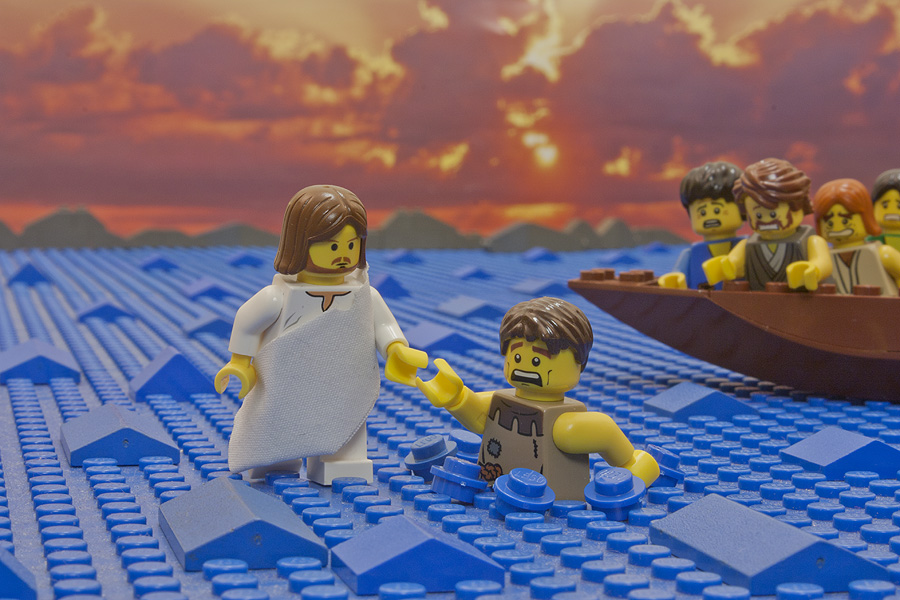
More water walking
Then Peter got down out of the boat, walked on the water and came toward Jesus. But when he saw the wind, he was afraid and, beginning to sink, cried out, “Lord, save me!” - Matthew 14:29-30.
Brendan Powell Smith illustrated this scene for his upcoming book: The Brick Bible: The New Testament. Here's his original version.

Brendan Powell Smith illustrated this scene for his upcoming book: The Brick Bible: The New Testament. Here's his original version.
Sunday, August 19, 2012
Nazca Lines
Between 400 and 650 AD, the Nazca people of what is now Peru dug a network of lines and figures in the earth covering a 50 mile distance. Some of these are geometrical patterns, while others are in the shapes of animals. While these can be seen from the surrounding hills, they are best viewed by air as Jackie Britton shows with an airplane flying over the 'hummingbird' formation. It is unclear what the purpose was, but one theory is that these were drawn to be seen by the gods in the sky. Another theory holds that these served as a type of astronomical observatory to help in the marking of certain rituals.

Saturday, August 18, 2012

Friday, August 17, 2012
Rescue of the Palladium
The Palladium was a wooden image of Pallas created in her memory by her foster-daughter, the goddess Athena. This fell from heaven in answer to a prayer by Illus, the founder of Troy, and became one of that city's greatest treasures. After the destruction of Troy, the Palladium was taken by Aeneas to Italy, and became a treasure of the new city of Rome. Okay, moving from mythic origins to history, the Palladium was seen by the Romans as one of their most sacred relics and a guarantee of the city's protection. It was kept in the Temple of Vesta, and in 241 BC the temple caught fire. The famous general and Pontifex Maximus Lucius Caecilius Metellus did not fear for his own life, but bravely plunged into the flames and came out carrying the precious Palladium, as shown by -lokosuperfluoLEGOman-. Metellus survived, but was blinded, and he was honored by the Roman Senate for his heroism.

Thursday, August 16, 2012
Scriptorium
In medieval times, a scriptorium (here by me) was the section of a monastery that kept the important texts, especially the Bible, and where monks copied them by hand.

My sig-fig over at Classic-Castle is the Precentor of the Scriptorium - the precentor was the monk in charge of this area of the monastery.

And here's a vignette I built to keep my sig-fig.

My sig-fig over at Classic-Castle is the Precentor of the Scriptorium - the precentor was the monk in charge of this area of the monastery.
And here's a vignette I built to keep my sig-fig.
Wednesday, August 15, 2012
Monk's cell
A monk is someone who has taken vows to leave behind a life of worldly ease to focus on prayer and other religious duties. While these are commonly connected with Roman Catholicism, there are Monks in other traditions such as Protestant Lutherans and Anglicans and also other faiths such as Buddhism. Ian spacek shows a typical medieval monk's cell.

Tuesday, August 14, 2012
Tyndale
Ian Spacek shows us William Tyndale, a leading figure in the English Reformation. Tyndale translated the Bible into English, in violation of English law and Church edicts at the time. For this, and for opposing the divorce of Henry VIII, he was ultimately executed in 1536.

Monday, August 13, 2012
Walking on water
During the fourth watch of the night Jesus went out to them, walking on the lake. When the disciples saw him walking on the lake, they were terrified. "It's a ghost," they said, and cried out in fear. But Jesus immediately said to them: "Take courage! It is I. Don't be afraid."
"Lord, if it's you," Peter replied, "tell me to come to you on the water."
"Come," he said. (Matthew 14:25-29a, NIV)
Ian Spacek shows us Jesus walking on water.

"Lord, if it's you," Peter replied, "tell me to come to you on the water."
"Come," he said. (Matthew 14:25-29a, NIV)
Ian Spacek shows us Jesus walking on water.
Subscribe to:
Posts (Atom)